
Avatar: The Last Airbender is one of those foundational pieces of animation that proved a kids’ show could handle heavy material without talking down to anyone, and its willingness to tackle real subjects for multiple audiences at once is a large part of why many of us (including me, here, on this site, even to this moment) do what we do. The Legend of Korra carried that forward, and this year’s Avatar Aang: The Last Airbender film, the one Paramount punted to streaming for bizarre (definitely not to distract from the firing of Colbert) reasons, kept the world turning. Now comes Avatar: Seven Havens, the first series to follow Korra, and three episodes in, it has made a strong, confident case for itself.
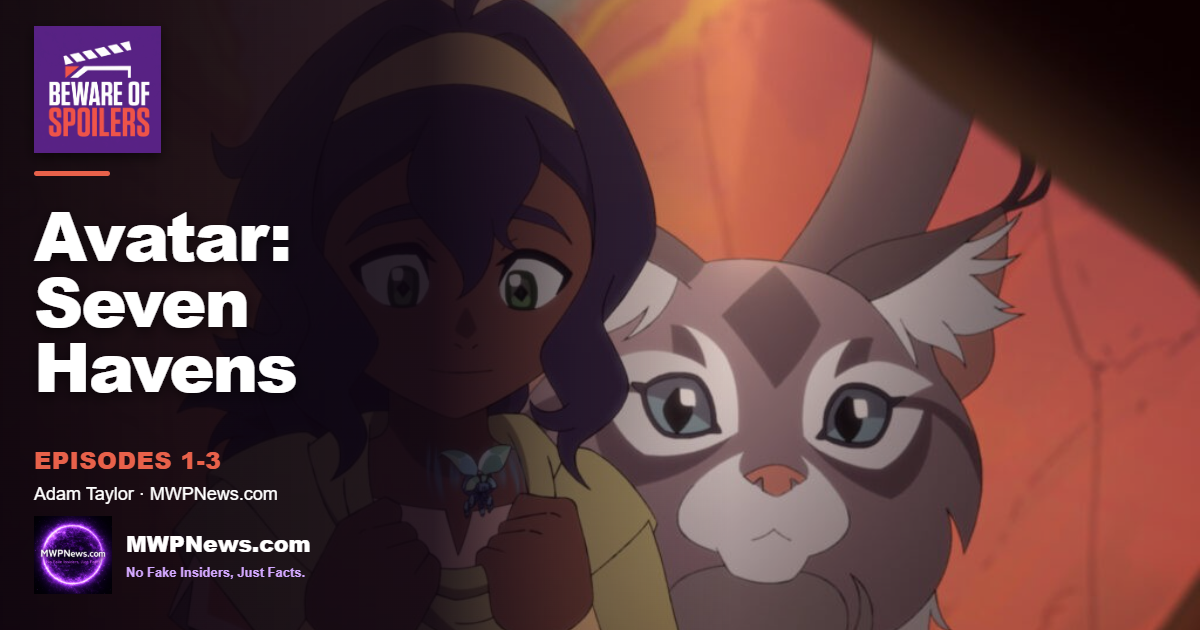
The premise is the boldest swing the franchise has taken in a while. Set 225 years after Korra, Seven Havens opens on a world shattered by a cataclysm that the surviving remnants of humanity blame on the Avatar herself. Civilization has retreated into seven fortified havens, and the Avatar is no longer humanity’s savior but its feared destroyer, so reviled that a resurfaced Avatar would be cast out into the wasteland to die. Into that world comes Pavi, a young Earthbender who learns she is the next Avatar, alongside a twist on the formula: she is one of twin Avatars, sharing the mantle with her long-lost sister Nisha. Two Avatars at once, in a world that wants them both dead, is a premise with real juice.
The smartest early choice is restraint. There is surely a version of this show that stops cold to explain exactly what the cataclysm was, what the anomaly is, and how Korra supposedly caused it, and Seven Havens wisely declines to deliver that infodump. It trusts you to sit in the mystery, and the show is better for it. Pavi herself is the other early win. The opening risks saccharine, introducing her as she stops to help a bug, the kind of beat that can curdle into insufferable do-gooder territory fast, and the show never lets it. Her kindness reads as character rather than affectation, and she is immediately, durably likable in a way that anchors everything around her.
The worldbuilding rewards fans without leaning on them. The haven the show settles in appears to be built on the ruins of Ba Sing Se, with the third episode taking us into something that strongly resembles the crystal catacombs from the end of the original series’ second book, now the relocated home of the White Lotus. It is a sharp inversion to make the White Lotus the group that still believes in the Avatar in a world that has turned against the idea entirely, and that tension, faith in the Avatar against a civilization’s terror of her, gives the show a different engine than either of its predecessors. Korra began with a fully-formed adult Avatar wrestling with existential problems both sociopolitically between benders and nonbenders, and with the convergence of the Spirit World; Aang began with a boy coming to terms with a destiny to end a war. This begins with a world that has decided the Avatar is the enemy, and watching Pavi come to recognize her destiny against that backdrop is a fresh angle on a familiar arc.
There is a nagging structural worry, though it is smaller than it first appears. The batch-release cadence, three episodes a Friday across Book 1, and the sheer concision of a serialized animated story can make you fear there is no room for filler, and the first three episodes do spend considerable time simply settling in and letting you learn who these characters are. With Book 1 running thirteen episodes rather than the shorter order it might feel like, there is more runway here than the pacing initially suggests, but the clock is still a concern; a lot of the early going is devoted to getting Pavi to accept who she is, and a serialized story on a schedule cannot afford to linger too long on that threshold. It is especially a little strange since each episode runs 23 or so minutes, rather than 30. It is almost as if it was designed to run on Nickelodeon like it's predecessors but moved to streaming, and the extra seven minutes (plus removal of lead-in and return-from act breaks) would have given more runway. Over 13 episodes, we are functionally talking about about 3 entire more episodes.
The supporting cast is likable but underused, chiefly the brigade, who feel held at arm’s length so far. That seems intentional: the show is deliberately keeping two halves of this world, the brigade and the White Lotus, from fully connecting yet, presumably saving the collision for when the Avatar brings them together. It is a reasonable structural choice, if one that leaves some of the most appealing characters waiting in the wings.
And then there is the theory, because this is the kind of show that invites one. A nefarious, Vaatu-like spirit is introduced early, showing Pavi and Nisha a dire possible future, and the third episode features an animal thrashing with red light in its eyes, the classic marker of spiritual corruption. Whether this is Vaatu or not, is it possible that this spirit is behind the cataclysm itself, and the version of events in which Korra destroyed the world never actually happened? The theory is that the apocalypse everyone believes in is a collective hallucination imposed by this spirit, a false history the whole world has been made to accept, and that breaking the illusion is what ultimately resolves the series. The timeline even nudges this way, since no one alive witnessed the cataclysm firsthand after 225 years, which leaves plenty of room for a spirit to have authored the story everyone now believes. We will see if it pans out.
Three episodes in, Seven Havens is confident, intriguing, and doing real work to distinguish itself from the shows that came before it while honoring what made them matter. The pacing bears watching and the brigade deserves more to do, but the premise is strong, Pavi is a lead worth following, and the central mystery has real pull. The next batch arrives Friday, and this one will be on the recap docket every week.