

The strangest thing a corporation can do is spend seventy million dollars making a movie about the dangers of unchecked corporate power and then bury it to save on its taxes. That is, more or less, the true story of what happened to Coyote vs. Acme, a film that was completed, shelved by Warner Bros. Discovery as a write-off, left for dead for years, and finally rescued by a scrappy independent distributor, and it is impossible to watch the finished product without that history sitting on top of every frame. Here is a David-and-Goliath comedy about a monolithic company that harms people because it believes, correctly for a long time, that it can get away with anything, made and then very nearly destroyed by a media conglomerate in the middle of being swallowed by an even larger one. The irony is almost too neat, and the happy surprise is that beneath it sits an incredibly strong movie.
Coyote vs. Acme takes the premise of Ian Frazier's classic New Yorker piece and runs a whole film on it: Wile E. Coyote, having spent a lifetime maimed by the faulty products he keeps buying to catch the Road Runner, hires a lawyer and sues the Acme Corporation for the damage. Will Forte plays Kevin Avery, the down-on-his-luck attorney who takes the case, John Cena plays Buddy Crane, the slick company man arguing for Acme, and Lana Condor plays Kevin's idealistic niece Paige, with Luis Guzmán and a deep bench of Looney Tunes voices filling out the world. Dave Green directs from a screenplay by Samy Burch, and the film reached theaters in August 2026 through Ketchup Entertainment, the same indie that turned the animated The Day the Earth Blew Up into a hit, after Warner sold it off for a reported fifty million dollars.
The praise it has drawn, best hybrid live-action Looney Tunes movie, best of its kind since Who Framed Roger Rabbit, comes with an asterisk, because the competition in that category is Space Jam and precious little else. What works most is the film's evident, bone-deep love for the Looney Tunes catalogue, expressed not through the obvious characters but through the deep cuts. The law firm Coyote turns to is named Avery, Jones and Maltese, a tribute to Tex Avery, Chuck Jones, and Michael Maltese, the writers and directors who built the characters and visual style established by the original shorts. The casting choices reach past the marquee names into the back bench: Foghorn Leghorn as the head of Acme, testifying before Congress in the cadence of a fast-talking Southern lawyer, is a masterstroke, and Elmer Fudd as the senator running interference for the corporation completes the picture. Bugs Bunny is reduced to a Deep Throat figure feeding information from the shadows; Daffy and Tweety get small but memorable roles and Sylvester has a cameo. The film understands that the strength of its concept means it does not need to lean on Bugs, and that restraint is a large part of why it works.
That structural cleverness serves a real theme, and this is where the film's content and its fate become inseparable. The movie is explicitly about a corporation that has done whatever it wants for so long that it no longer believes anyone can stop it, a point Forte's lawyer states outright in the run-up to the climax, after Luis Guzmán's judge dismisses the case: they think they can get away with anything because they always have. The oppressed class here is literal, the cartoon characters used as unwitting test subjects for Acme's lethal products, and the villains are the two figures lending the corporation a veneer of legitimacy, the executive and the senator insisting nothing is wrong. It is not subtle, and it is not meant to be. It is a broadside against corporate impunity, which is exactly what makes its real-world story land like a punchline the film did not intend.
The temptation is to say Warner buried this because of its message, but there is no evidence of that. The documented reason was the tax-write-off strategy Warner Bros. Discovery pursued after its merger, a cold accounting decision that also claimed the finished Batgirl and other titles. But you can hold the fact and feel the irony at the same time. A film about a corporation crushing the little guy, made by a corporation, killed by that corporation for a tax benefit, and now released into a moment when Warner itself is being bought by Paramount, does invite the question, even if the answer is probably just money. The film seems to know it, too. There is a dig hiding in the opening logo, an asterisk on the Warner Bros. shield noting it is a wholly owned subsidiary of the Acme Corporation, and whether that gag was in the original cut or added on the way out the door, it is the movie winking at its own predicament.
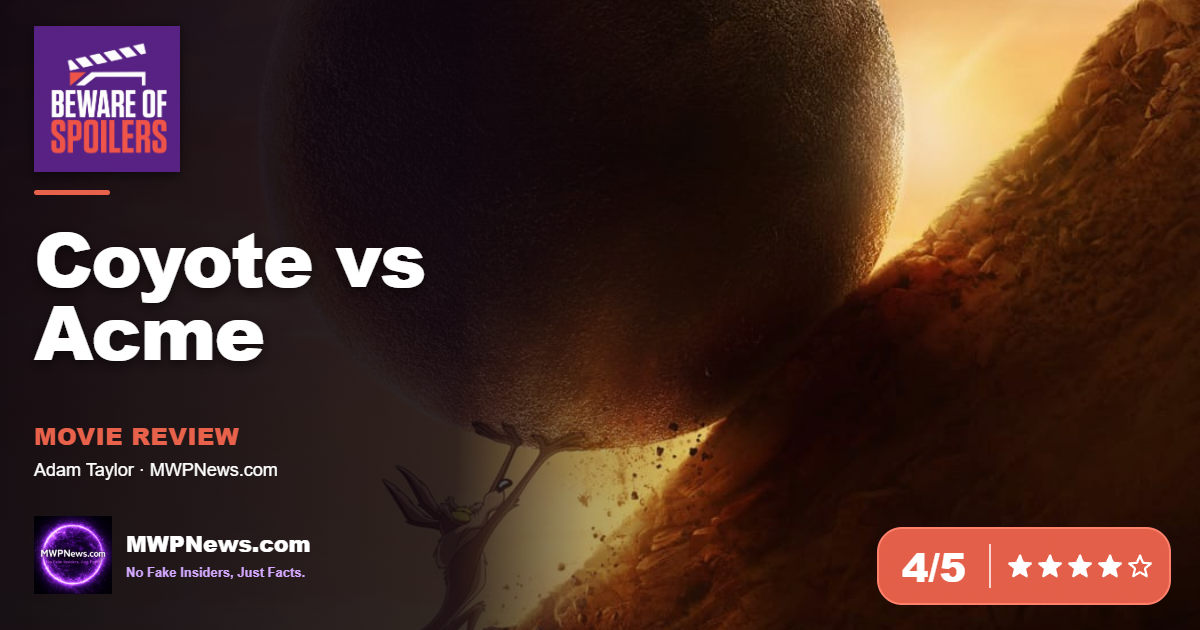
The one real weakness, and the thing keeping this from a five out of five, is the human relationship at its center. The film sets up a shared history between Forte's lawyer and Cena's opposing counsel, two men who knew each other before ending up on opposite sides of the case, and then never leans into it. That backstory should be the emotional engine, especially given the Sisyphus metaphor the film keeps reaching for, the coyote condemned to push the boulder up the hill forever, the lawyer who keeps losing but refuses to stop. A stronger version of the movie would have used the Cena-Forte history to deepen that idea of dogged, doomed persistence, and instead the connection is stated and dropped. The Paige subplot fares better, Condor's idealistic aspiring lawyer set against her uncle's worn-down cynicism gives the film its best character dynamic and its funniest exchange, a deadpan bit before Congress about a refrigerator, a freeway, and eighty miles per hour that is the comic high point of the whole thing. But the central adult relationship needed the same care, and its thinness is the seam that shows.
Coyote vs. Acme is a warm, clever, deeply felt movie that had every reason not to exist and clawed its way onto screens anyway, and the fact that it is this good only sharpens the question of why anyone thought burying it was a smart idea. It calls the judgment of the executives who shelved it into real doubt, and it makes you wonder, uncomfortably, what Batgirl actually was, whether that film too was better than the write-off implied, and whether Leslie Grace got robbed of a career-making role by the same cold math. The recommendation here is simple, and a little spiteful: go see it in a theater. Ketchup Entertainment paid fifty million dollars for a movie Warner Bros. decided was worth more as a tax deduction, and the best way to prove how wrong that call was is to make the rescue pay off. Show them the mistake they made. The coyote finally got his day in court. He deserves an audience for it.