

There is a specific kind of movie that barely exists anymore, the mid-budget film made for adults. I'm not referring to an R-rated franchise entry or a prestige awards play but simply a well-crafted, funny, interesting picture for grown-ups to enjoy for two hours and then talk about on the drive home. A decade ago that kind of film was already endangered, and one of the clearest casualties is also one of the best: Shane Black's The Nice Guys, which arrived in the spring of 2016, got swallowed whole by the blockbuster machine, and has spent the ten years since being slowly, deservedly rediscovered. Revisiting it now, two things become clear: it is a great movie, and its failure was an early warning sign for a kind of filmmaking we have almost entirely lost.
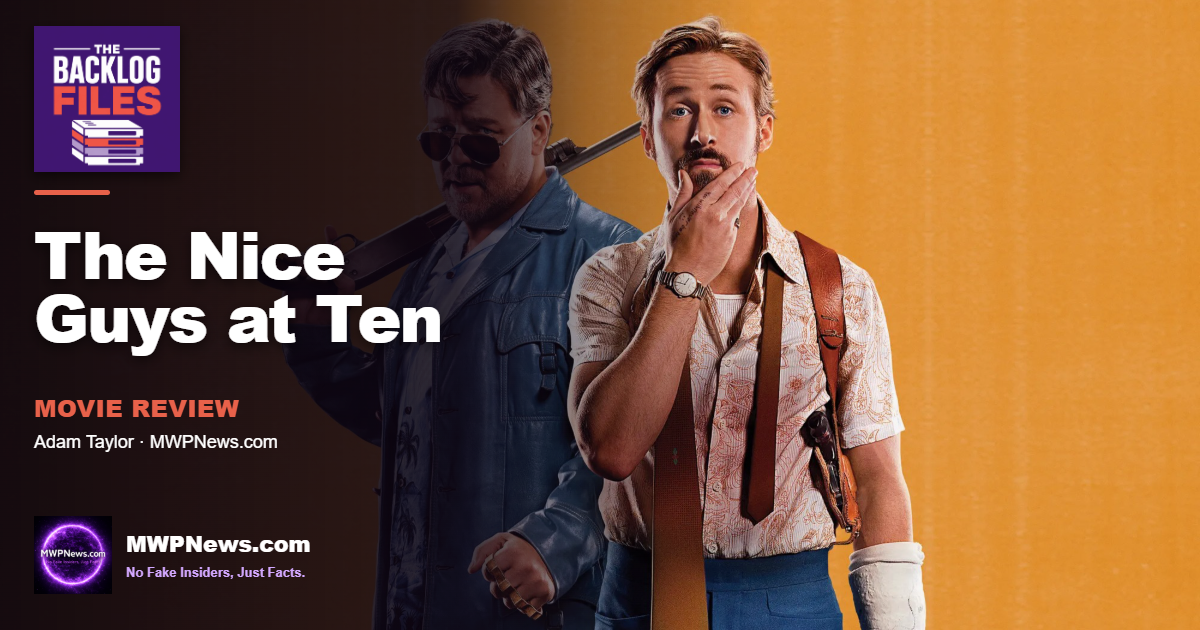
The Nice Guys is set in a grimy, sun-bleached 1977 Los Angeles, where Holland March, a barely-competent private investigator and single father, is hired to look into the apparent suicide of a porn star and winds up tangled with Jackson Healy, a freelance enforcer with a set of brass knuckles and a conscience he would rather not admit to. The two are pulled into a conspiracy involving a missing girl, with March's sharp, disapproving thirteen-year-old daughter Holly trailing along as the closest thing either man has to a moral compass. Ryan Gosling plays March, Russell Crowe plays Healy, and Angourie Rice plays Holly, in what was her first real mainstream role, years before she became familiar as Betty Brant in the MCU's Spider-Man films or turned up in this year's Finding Emily. Shane Black directs, his first film behind the camera since Iron Man 3 in 2013.
This is not a buddy comedy so much as an anti-buddy comedy. The standard version of this pairing gives you two partners so in sync they finish each other's sentences, a well-oiled machine of mutual understanding. March and Healy are the opposite: openly contemptuous of each other for much of the runtime, at cross purposes as often as not, and anything that goes right for them tends to happen by accident rather than design. That friction is the engine. Watching two men who do not particularly like each other stumble into competence is far funnier and more human than watching a slick team execute a plan, and the chemistry between Gosling and Crowe, who play that mutual exasperation to perfection, is the reason the film has endured.
Dropping Holly into the center of that is the film's secret weapon. A thirteen-year-old who knows exactly what her father does for a living and judges him for most of it provides both a steady moral center and a bottomless well of comedy. The film's best gag is a small one, Holly flinging a cup of coffee at a woman she is trying to intimidate, her sputtering about why she threw cold coffee at her, her explaining that she thought it would be hot, and Gosling's March approving of the attempt anyway, telling her he likes where her head's at. It is the kind of beat that only works because the film has so precisely calibrated the relationship between these three people, and it is representative of how much the movie wrings out of character rather than plot.
The period setting is not just dressing, either, and this is where Black's craft shows. The Nice Guys does not merely take place in the seventies; it feels like a movie from the seventies, in the way it is shot, in how the actors move through space, in its whole visual grammar. It consciously harks back to the golden age of revisionist detective thrillers, and the commitment to that register is a large part of what gives it its texture. There is even a modern resonance to its plot, a story about little guys bumping up against entrenched corporate power, that reads as pointed today, though the slightly deflating truth is that the same rot it depicts was already there in the seventies. The more things change, as the film quietly understands, the more they stay the same.
Looking back, The Nice Guys also turns out to be a hinge point in Ryan Gosling's career, and arguably the most consequential performance he had given to that point. Audiences knew Gosling from romantic dramas and brooding leading-man roles, but this was the film that revealed him as a gifted physical comedian, willing to pratfall and flail and look ridiculous with total commitment. You do not get the Gosling of Barbie or The Fall Guy without The Nice Guys first proving he could do this, that there was a live-wire comic performer underneath the matinee idol. It is the foundation a whole second act of his career was built on, and it makes the prospect of his upcoming Star Wars: Starfighter genuinely exciting (even if I remain skeptical about his fit for Ghost Rider coming in a couple of years).
Which brings us to why this appreciation carries an undertone of lament, because the story of The Nice Guys is also the story of what happened to movies like it. The film opened on a brutal weekend, landing behind The Angry Birds Movie, Captain America: Civil War in its third weekend, and Neighbors 2. It grossed a disappointing eleven million on its opening weekend against a fifty-million budget, and that number, more than any failure of quality, is why there was never a sequel. The reviews were strong; the audience simply was not there, drowned out in a sea of franchise IP. And 2016 was one of the first years that sea truly closed over everything, a glut of brand-name tentpoles that left little room for anything else, a pattern that would repeat and intensify. The slow disappearance of the mid-budget, well-made adult picture, is something we are still living with; the occasional Black Bag or a genre throwback like it reminds you how good these movies can be and how rarely we get them now.
So the recommendation is simple, and a little wistful. Go back and watch The Nice Guys if you missed it, and most people did, because the odds are good you will walk out of it wondering why you never heard of it at the time. The answer is that it came out at exactly the wrong moment, swallowed by the machine, a casualty of the very trend it now helps you see clearly in hindsight. It deserved better then, and it deserves an audience now. Maybe, someday, we even get that sequel. Stranger things have happened, and few movies have earned one more.