
History has a way of reducing the actual impact of events on the people who participate. The coups and covert operations that reshaped the twentieth century arrive in a textbook as dates and names like the Bay of Pigs invasion and the Chilean coup. They become sterile recitations of events that happened to abstractions rather than to people, even though many of those people are still alive, and some of them were in the room. The quiet achievement of Wild Horse Nine, Martin McDonagh’s first film since The Banshees of Inisherin, is that it reaches into one of those bloodless historical footnotes and puts the human cost back. It is also, for the record, a very funny movie, and one of the best of the year.
Wild Horse Nine is set in 1973 Chile, in the months before the coup that would topple the democratically elected socialist Salvador Allende and install Pinochet, an outcome the United States, through the agents at the film’s center, spent a year engineering. Those agents are Chris, a seasoned, ornery, increasingly forgetful CIA operative played by John Malkovich, and his longtime partner Lee, played by Sam Rockwell, and the film follows the two of them as they are dispatched from Santiago to Easter Island on a mission that doubles as a reckoning, with the end of Chris’s career and his life both plainly in sight. Steve Buscemi plays their bureau chief, and Parker Posey and Tom Waits also star. McDonagh writes and directs.
The single strongest element of the film is John Malkovich, who is giving the kind of performance that wins awards and should win him a Best Actor nomination here. His portrayal of Chris is a man whose mind is going but not yet entirely gone, lucid in flashes and adrift in others, carrying a career’s worth of monstrous work and the haunting knowledge that he is running out of time to make any sense of it. Malkovich plays the whole fractured range of it, the senility and the sharpness, the rage and the confusion and the sudden heartbreaking clarity, and he does it without ever losing the thread of the man underneath. A phone call to his brother, a handful of lucid moments alongside Rockwell, these land with real force precisely because the character is never fully present, so the moments he surfaces hit like something recovered. It is a towering piece of acting, and the festival circuit has already begun to recognize it.
Rockwell is the ideal counterweight, which is its own kind of craft. A performance as volatile as Malkovich’s needs a partner who can absorb it without competing with it, and Rockwell’s Lee is exactly that, not chaotic but easy, a go-with-the-flow presence who takes each of his partner’s lurches from mania to fury to bewilderment in stride and keeps the scene moving. The two of them form a double act with the lived-in rhythm of men who have worked together long enough to read each other’s silences, and watching them play off one another is the film’s deepest pleasure. Parker Posey, in two scenes, arrives like a hurricane and makes both of them count, memorable in a small space the way Olivia Wilde was in Behemoth! (well, will be, the movie isn't officially out yet) earlier this year.
The film’s real argument is where McDonagh’s choice of subject pays off. By spending its time with these two men and the people their work touches, Wild Horse Nine insists on the human reality of what American intervention actually did on the ground. The abstraction of destabilizing a government becomes concrete when the film puts the agents face to face with someone whose life their mission will upend, a person rather than a line in a history book. That is the whole point, to collapse the comfortable distance between the historical event and the human being on the receiving end of it, and the film does it without lecturing, letting the weight accumulate through character rather than speech. It is McDonagh’s most political film, and it earns that description by making the politics personal.
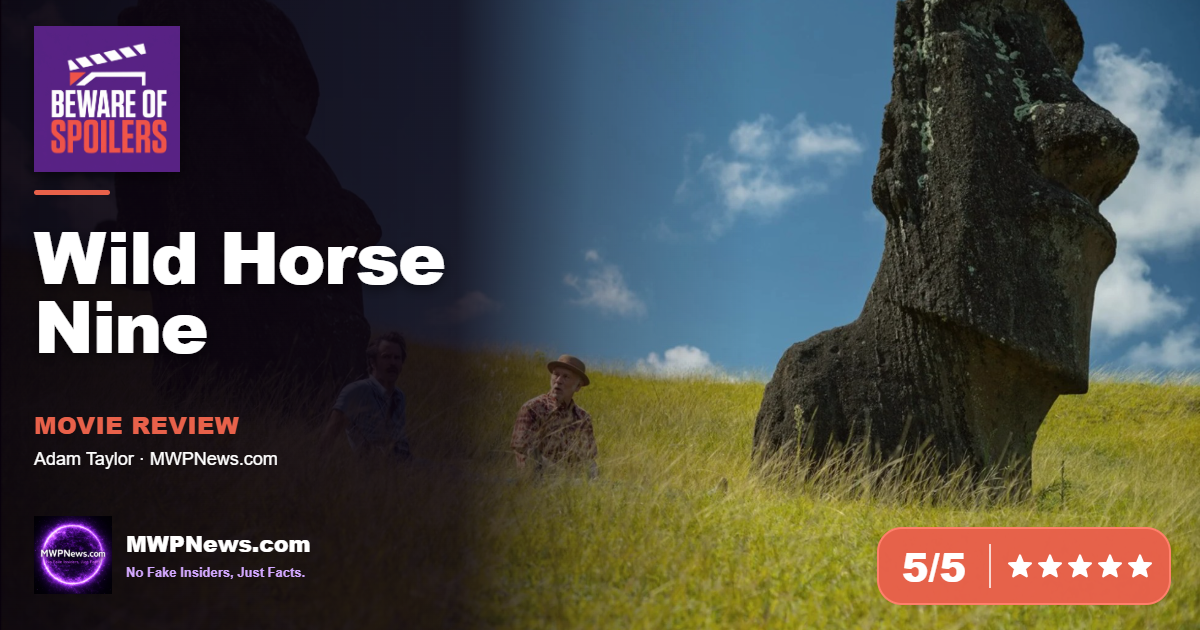
A final, smaller note worth making, because it is part of why the film works as well as it does: the commitment to shooting outdoors. It sounds like faint praise, but there is something bracing about a film that plants itself on Easter Island and simply lets the place be what it is, including the moments when passing cloud cover changes the light mid-scene and the image shifts with it. Rather than fight the elements into a controlled, sterile look, the film lives in them, and the result is a sense of real weather and real place that grounds the whole thing, a visual honesty that rhymes with the emotional honesty at its center.
Wild Horse Nine is the complete package, a dark, funny, profound film anchored by two actors working at the absolute peak of their powers and built around an idea that matters. It takes a piece of history most of us learned as an abstraction and makes it ache, and it does so while being enormously entertaining, which is the hardest trick of all. Malkovich alone would make it worth the ticket; everything around him makes it one of the year’s best. See it in a theater when it opens near you. This is the kind of movie the medium exists for.