

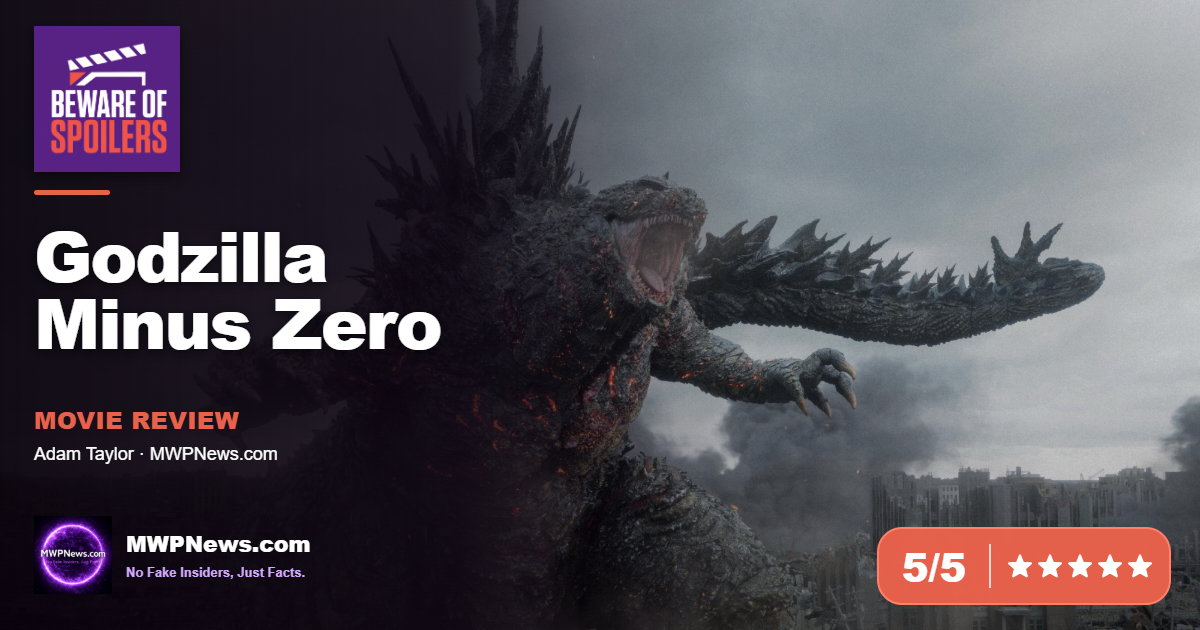
The great trick of the best Godzilla films is that the monster is never really the subject. Across seventy years, Godzilla has been a mirror the culture holds up to its own anxieties, the trauma of the atomic bomb, the terror of nuclear proliferation, or the fear of a nature we provoked and can no longer control. He is a societal chameleon who takes whatever shape the moment demands. Godzilla Minus One understood that better than any entry in a generation, grounding its spectacle in the human cost of catastrophe, and the question hanging over its sequel was whether lightning could strike twice. Godzilla Minus Zero answers it emphatically. It is that rare sequel that extends what made its predecessor great rather than merely repeating it, and it is one of the best films of the year.
Godzilla Minus Zero is set in 1949, two years after the events of Minus One, and returns to the Shikishima family who anchored that film, Kōichi and Noriko, still living in the shadow of what they survived. The story braids together two men shaped by the war in opposite directions. Kōichi carries the guilt of what he did and became during it, now trying to protect the fragile life he has rebuilt. Murakami, a professor who lost his entire family at Hiroshima, has engineered a means of directing Godzilla and intends to use it to take revenge on the United States by unleashing the creature on American soil. Takashi Yamazaki returns to write, direct, and lead the visual effects, with the three-headed King Ghidorah, absent from a mainline film (excluding Legendary's films) for over two decades, as the monstrous threat that forces the question the whole film is built around.
The human element of Toho's two most recent Godzilla movies is what makes these so much more than the spectacle. So many kaiju films are fundamentally about destruction, the camera lingering on a leveled Tokyo, and the problem with pure destruction is that it is weightless, especially when, as with the classic Showa films rewatched alongside this one, you can see the balsa-wood buildings and the man in the suit. Minus Zero understands that the devastation only matters if you feel it as human loss, and it earns that feeling by routing its spectacle through character. The film’s most powerful sequence is a vision of Godzilla attacking New York, and it lands not as spectacle for its own sake but as the horrifying endpoint of Murakami’s logic, the image of the Ginza attack from the first film and the memory of Hiroshima turned outward onto a new target. It makes the destruction mean something, which is the whole game. When it was announced to be R-rated, I was hesitant and thought it would be some gratuitous Jurassic World-style murder of the assistant but, after seeing it, there is no other rating this movie could be.
The theme underneath it all is the cycle of violence, and the film has the conviction to resolve it honestly. Murakami’s plan is revenge, answering the atrocity visited on Hiroshima by visiting one on America, and the film’s climax is a repudiation of exactly that impulse. To unleash Godzilla elsewhere, the film concludes, is not justice but replication, creating another Murakami, killing another million people, ensuring someone down the line does to you what you did to them. The best revenge is to end the cycle rather than extend it, and arriving at that through a monster movie, earning it through character rather than sermon, is an achievement. It is the clearest expression yet of what Godzilla, as a symbol, can still be made to carry.
The geopolitics are handled with real nuance, too, which is not a word often applied to kaiju cinema. The film sets itself in the specific reality of 1949, the Asia-Pacific in the shadow of a looming Korean War, with the United States seeking to expand its sphere of influence in the region to contain the spread of communism. It does not shy from depicting the Americans attempting to leverage both Japan and Godzilla himself as instruments against the Soviets, and it renders that power dynamic, the effort to work with a defeated Japan while also controlling it, with more texture than the period usually gets on screen. The film has a point of view about that history and trusts the audience to sit with it.
The craft backs the ambition. The practical and effects work, achieved by Yamazaki and a tiny team at a fraction of the cost of any Hollywood production of comparable scale, gives everything a tactile weight that the all-digital spectacle of the American MonsterVerse films, by comparison, rarely manages. And when the monsters finally collide, the film delivers. The fight between Godzilla and King Ghidorah is spectacular, worth the price of admission on its own, and Ghidorah’s design here is phenomenal, an awe-inspiring realization of the three-headed dragon. For all the thematic weight the film carries, it never forgets to be a thrilling creature feature.
If there is a weakness, it is in some of the family material, which does not land as cleanly as the rest. The film’s handling of the Shikishima relationship, and particularly a late sequence built around leaving and then not leaving, reaches for an emotional payoff it has not fully earned, and the result is a beat that plays as manipulative where the rest of the film plays as true. It is a minor stumble in a film doing so much else well, and worth noting mainly because the surrounding material sets such a high bar.
Godzilla Minus Zero is the complete kaiju film, a monster movie with a brain and a conscience that is also a thrilling spectacle, and it extends the promise of Minus One rather than coasting on it. It takes a seventy-year-old symbol and makes it mean something new, it stages a monster battle for the ages, and it does both at a scale and a cost that shames productions many times its budget. As for where the franchise goes next, the film plants seeds, and the smart money is on a direction that keeps the man-made, controllable threat at its center rather than reaching for the cosmic. Wherever it goes, this is the rare sequel that makes you eager to follow. See it on the biggest screen you can find. This is why the monster endures.