
There is a particular flavor of Marvel project that feels like a message from an earlier, more optimistic era of the franchise, back when the pitch was that every film and every show would lock together into one enormous interconnected machine. The MCU has largely abandoned that promise, and the recent split of Marvel Television from Marvel Studios made the retreat official. This is what makes VisionQuest such an interesting arrival. As the last live-action MCU show before Doomsday, and one of the last before next year’s Daredevil and the mysterious Zodiac beyond it, VisionQuest ties back to the broader universe in a way that feels intentional, a relic of that original, ambitious vision, and two episodes in, it is a pleasure precisely because of that.
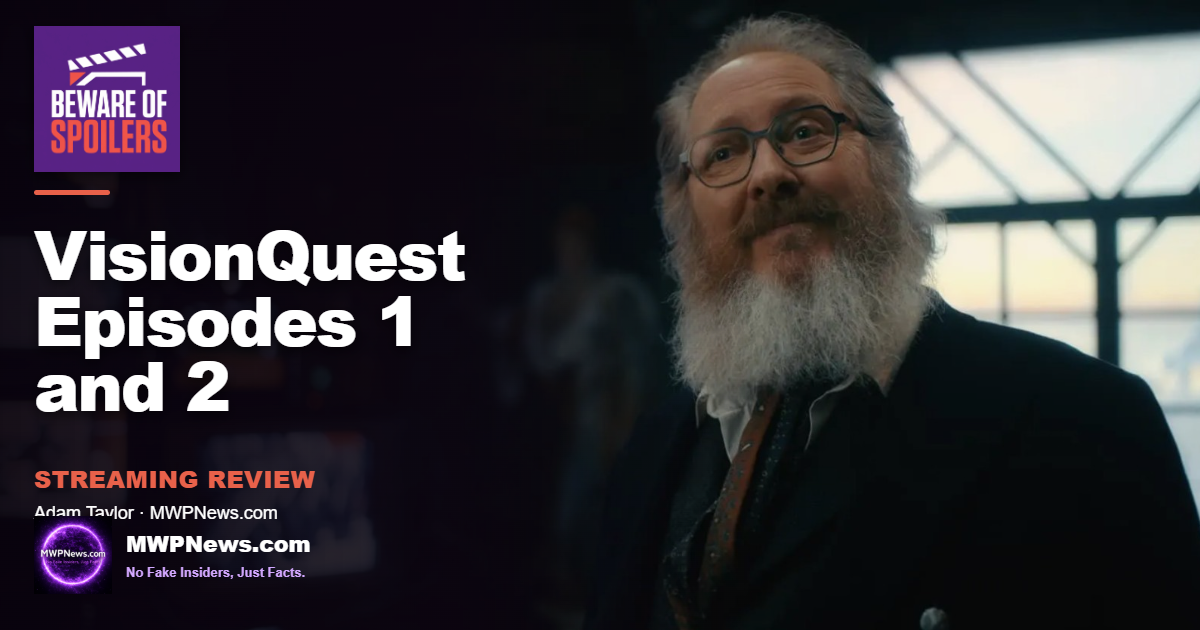
The strongest thing here is James Spader, who finally gets the Ultron that Age of Ultron never quite let him play and only ever alluded to. That film has always been a mixed bag, with real highs and real lows, and one of its shortfalls was that Spader’s Ultron was sold as something more menacing and more magnetic than the finished movie delivered. VisionQuest corrects that. Returning as Ultron for the first time since 2015, now manifesting as a human avatar inside Vision’s mindspace, Spader leans into exactly the register that made him so good on The Blacklist: matter-of-fact delivery with a current of real menace running underneath it. It is the version of the character that was always promised, and getting to watch him finally dig in is one of the show’s chief pleasures.
That performance is set against Vision himself, wrestling with who he is in the aftermath of WandaVision, and the dynamic between them is the show’s engine. This is, crucially, Vision Two, built in WandaVision after the original Vision died in Infinity War, and the series makes his struggle to come to terms with that identity its central thread. The mindspace conceit, where Ultron and Tony Stark’s other old AIs manifest as human personas, is a clever framework, and the production design that renders it is a highlight across the board, especially the sixties-and-seventies aesthetic Vision adopts as he builds out the house of his own mind. Among the supporting AIs, Emily Hampshire’s E.D.I.T.H., the AI from the Far From Home glasses, is the standout; the others land hit or miss. Oddly enough F.R.I.D.A.Y. has been recast, now played by Orla Brady rather than Kerry Condon, who voiced her in the films and is very much still working.
The show’s one real weakness is repetition. VisionQuest spends a lot of its early runtime re-treading the same idea, that this is not the same Vision who died, that he is someone new. It reminds me of Iron Fist to an extent, and that is not meant as the insult it sounds like, because this show is far better made than that one. Iron Fist burned its opening episodes on Danny Rand trying to convince everyone he was Danny Rand, and VisionQuest has a similar problem, circling the “I am a different Vision” point more than it needs to. We the audience already know this in both cases and having the main character spend screentime convince other people of that is wasteful. The frustration is sharpened by the knowledge that it is almost certainly building toward Vision reassuming some element of his old self anyway, so the extended insistence that he is wholly new reads as time borrowed against a conclusion the show has already signaled.
What keeps the interconnection from feeling like empty fan service is how deep it goes. The villain through the first two episodes, the bounty hunter chasing Vision, is Paladin, a deep cut created by Jim Shooter and Carmine Infantino who first appeared in Daredevil #150 back in 1978, a pointed choice given that the only other MCU show still ongoing is Daredevil. The series also threads in a reference to Adamantium, which in the MCU originates from the Celestial that Sersi transformed in Eternals, a lineage later picked up in the Captain America corner of the universe. These are not idle nods; they are the connective tissue the Multiverse Saga once promised everywhere and now delivers only rarely, and VisionQuest clearly relishes being the show that still bothers.
The early mysteries have real pull, chief among them who actually hired Paladin to bring Vision in. Ultron is the obvious suspect, which is precisely why it feels too obvious, and the same goes for the shadowy-organization answer. The more interesting possibilities are Wanda (if there isn't a body, she's not dead), the only other person with a personal stake in tracking this Vision down, or Billy trying to find his brother and father. It is nice that the show introduced Tommy quickly and up front rather than dragging out as an Agatha All Along-style guessing game. That restraint, naming Tommy up front instead of teasing his identity for episodes, is a sign the show has learned from the franchise’s recent habits.
Two episodes in, VisionQuest is confident, handsome, and anchored by a villain performance a decade in the making, held back only by an early-season tendency to circle its own premise. For anyone who misses the version of the MCU where everything connected, this is the closest thing left, and it is well worth staying with. New episodes land weekly, and this one will be on the recap docket as the season unfolds.