
The hardest adaptation to pull off is the one where the book’s greatest strength is the thing the movie cannot replicate, because then the filmmakers have to find a different virtue entirely, or fail. Suzanne Collins’s The Ballad of Songbirds & Snakes is written, unlike the other Hunger Games novels, in tight third person, and in this case the perspective belongs to Coriolanus Snow, the young man who will one day become Panem’s tyrant. The novel lives inside his head, and that interiority is both its engine and its problem. With Sunrise on the Reaping arriving in theaters this week, it is worth returning to the film that preceded it, because the 2023 adaptation does something rare: it takes the book’s defining feature, throws it out, and becomes better for the loss. This is the best film the franchise has produced, and the reason is a single act of adaptational nerve.
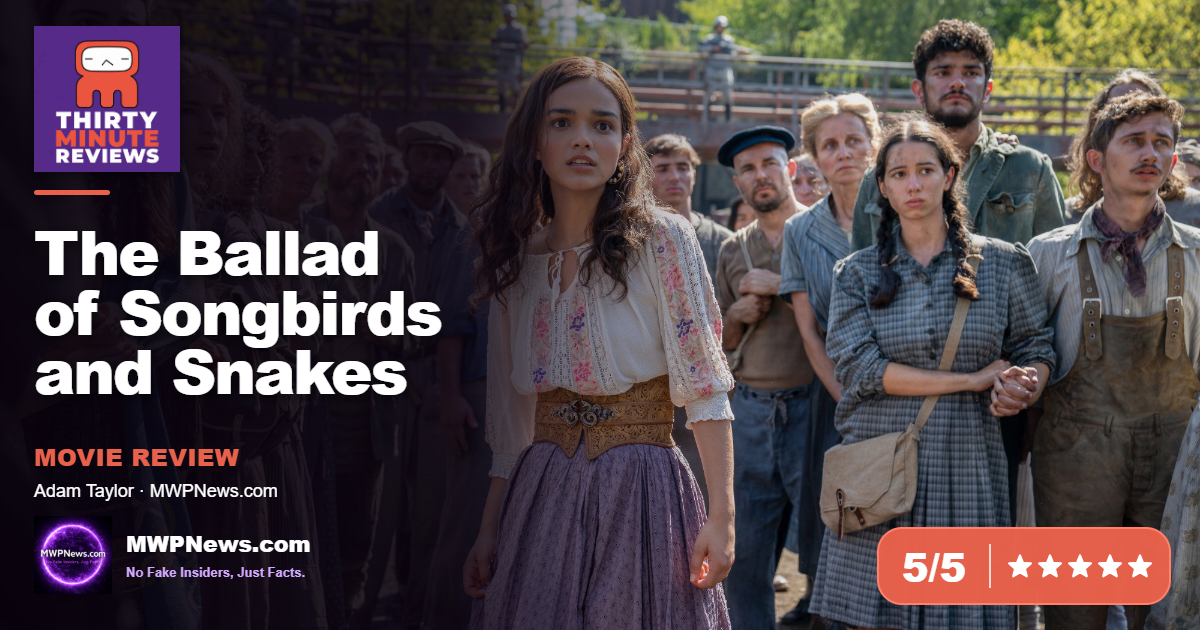
The Ballad of Songbirds & Snakes is set decades before Katniss Everdeen, during the tenth Hunger Games, when the spectacle is still a crude, unloved affair rather than the glossy machine it will become. Coriolanus Snow, scion of a once-great Capitol family fallen on hard times, is assigned to mentor Lucy Gray Baird, the tribute from District 12, and as her charm wins over the audience, Snow sees in her a path back to the prominence his family has lost. Tom Blyth plays Snow and Rachel Zegler plays Lucy Gray, with Viola Davis, Peter Dinklage, Jason Schwartzman, and Hunter Schafer also starring. Francis Lawrence directs.
Interiority is how a story conveys a character’s inner life, and prose has a dozen tools for it, internal monologue, descriptive access to thought, an omniscient narrator who can simply tell you what someone feels. Film has almost none of them; it can show you events and faces, and little else, which is why movies that reach for literal internal monologue so often feel stilted (*ahem* Love Hurts *ahem*). The Hunger Games books lean hard on interiority, and the main trilogy’s films paid a quiet price for it, because so much of Katniss’s story is her private awareness that she is being swept along, explicitly not in control, and Jennifer Lawrence, a fine actress, could only surface so much of that interior reality from the outside. Losing the narration flattened her, through no fault of her own.
With Snow, that same loss becomes a gift. The novel’s interiority is precisely what makes the book’s version of Snow a problem: inside his head, you watch him deliberate, agonize, waver between love and ambition and loyalty and revenge, and the cumulative effect is a good boy pushed toward evil, a sympathetic young man the circumstances corrupt. That framing undercuts the entire point, because we know what Snow becomes, and softening his origin into a tragedy of external pressure lets him off a hook he should hang on. The film fixes this by giving you none of it. Stripped of his internal monologue, Snow becomes unreadable, and Tom Blyth plays that unreadability as cold, detached calculation. You never know why he does what he does. Maybe he loves Lucy Gray. Maybe he is only using her to save his family. Maybe the ambition was always the whole of him. The film refuses to tell you, and that ambiguity is far more chilling than the book’s explained descent, because it suggests the capacity for monstrousness was there from the start, waiting, rather than installed by misfortune. Blyth’s performance is the film, and it works precisely because the script trusts his face to withhold what the novel spelled out.
That choice serves a larger thematic clarity the film brings to the whole Hunger Games idea. Set at the tenth Games, the film is fundamentally about the invention of the spectacle, the moment the Capitol works out how to turn mass punishment into mass entertainment, introducing sponsorship, gambling, and the televised packaging of tributes as personalities. The key scene is Snow’s conversation with Viola Davis’s Dr. Gaul about what the Games are actually for, and the answer reframes the entire franchise. The Capitol does not need the Games to kill; it could execute a child from each district in the square and be done with it. What the Games provide is something subtler and more durable, a sliver of hope, the possibility of winning, and a mechanism for turning the districts’ suffering into a show that divides them against one another. It recalls the manifesto at the heart of Andor, the insistence that authority is brittle and unnatural and requires constant attention to maintain. The Games are that constant attention made into content: keep the districts watching, keep them hoping, keep them fighting each other as tributes so they never turn as one against the Capitol. It is, in essence, an engineered culture war in the most extreme sense, and the film understands that is the Games’ real function in a way the earlier entries only implied.
The rest of the film more than holds up its end. Rachel Zegler is excellent as Lucy Gray, and the casting is inspired, because the role demands someone who can actually sing and carry the emotional weight of the Covey’s music; her reaping performance of “Nothing You Can Take From Me” and her development of “The Hanging Tree” are among the film’s high points, and they land because Zegler is doing the real thing rather than miming it. The arena sequences look great, and crucially the action is never idle spectacle; every beat of it is in service of showing who Snow is, a creature of the Capitol who survives because he has the means to operate within its system. Considering how Catching Fire is a weird turning point for action in mainline action movies, it's good to see this carries over the visual language established by John Wick's Chad Stahelski. Peter Dinklage, as Dean Highbottom, delivers one of the film’s quietly devastating moments, explaining the true origin of the Hunger Games shortly before his death, a scene that recolors everything around it.
There is a nice poetic symmetry (even if it is as subtle as a sledgehammer) in the film’s back half, too, as Lucy Gray, piecing together the depth of Snow’s betrayal and his hand in the death of Sejanus and the exposure of the rebels, declares she is going out to harvest some katniss, a wink at the future that is on the nose and lovely anyway, before disorienting Snow with a snake and vanishing as the mockingjays descend and the hanging tree swells. It is world-building that may not have been strictly necessary, but it enriches the mythology rather than merely servicing it, planting the seeds of everything the later films will reap.
The Ballad of Songbirds & Snakes is the finest film in the Hunger Games series, and a genuine rarity, an adaptation that is better than its source precisely because it understood which of the book’s qualities to abandon. By denying Snow the interiority that made him sympathetic on the page, it makes him something far more frightening: a man whose evil needs no explanation, because it was never really absent. With Sunrise on the Reaping now arriving to continue the saga from Haymitch’s perspective, and presumably another movie to follow (maybe Finnick?), it is the perfect moment to appreciate how high this prequel set the bar. See it, or see it again. It is the best this franchise has ever been.
★ ★ ★ ★ ★