

 Tom Holland (Actor), Michael Keaton (Actor), Jon Watts (Director) & 0 more Rated: PG-13 Format: Blu-ray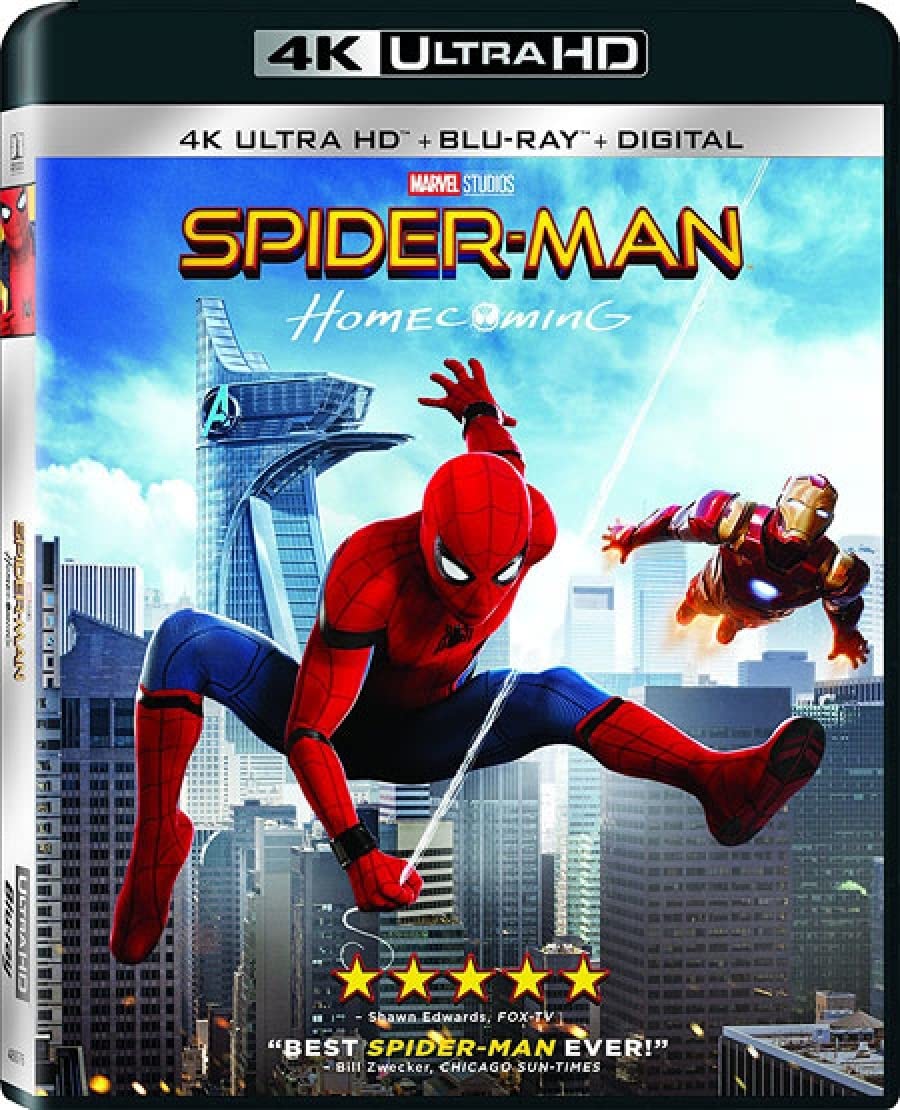
The trouble with building a cinematic universe on one charismatic character is that his shadow falls across everything that comes after, including the movies that are supposed to belong to someone else. Marvel spent its first phase making unlikely heroes into household names precisely because it had no choice; in 2008, Iron Man and Captain America and the Hulk were second-tier properties, not the pop-culture titans they are now, and the studio had to make good films because brand recognition alone would not fill seats. By 2017 that scrappiness had curdled into something closer to dominance, and Spider-Man: Homecoming, the first film produced under Sony and Marvel's landmark co-production deal, arrives as both a delightful high-school comedy and a quiet demonstration of how completely Tony Stark had come to swallow the universe around him. It is a very good movie with a lead who never quite gets to be the protagonist of it, and a decade on that tension is the most interesting thing about it.
Spider-Man: Homecoming follows Peter Parker, a fifteen-year-old in Queens juggling high school with his new secret life as a superhero, freshly returned from an Avengers mission and desperate to prove himself worthy of a permanent spot on the team. When he stumbles onto a black market in salvaged alien technology run by Adrian Toomes, a blue-collar contractor turned arms dealer who flies a scavenged winged suit, Peter throws himself at a threat that Tony Stark keeps insisting is above his pay grade. Tom Holland plays Peter, Michael Keaton plays Toomes, and Robert Downey Jr., Marisa Tomei, Jon Favreau, Zendaya, and Jacob Batalon also star. Jon Watts directs.
This lands at a 4 out of 5, and the single strongest reason is Michael Keaton. His Vulture is that rare Marvel villain with a coherent, sympathetic motive, a working man who lands a lucrative city contract cleaning up the wreckage of the Battle of New York only to have it yanked away by a federal agency, the Department of Damage Control, backed by one of the wealthiest men on the planet. Screwed over by the system and by Stark specifically, Toomes decides to provide for his family by any means available, and Keaton plays every note of that resentment as legitimate grievance rather than cackling villainy. It pays off in the film's best sequence, the car ride where Toomes, driving Peter to the homecoming dance, slowly realizes who is sitting in his back seat. The dawning recognition, the shift from small talk to quiet menace, is a masterclass, and it is the scene the entire movie is built around. Holland matches him beat for beat, and the two of them turn a superhero movie into a genuine thriller for five unbearable minutes.
The film around that relationship is charming, funny, and smartly scaled to its teenage hero. Watts understands that a fifteen-year-old's stakes are different, that failing to stop an arms deal and missing the homecoming dance can carry equal weight in a kid's life, and the movie mines real comedy and real tension from that smallness. It is a smart correction after two prior franchises that kept trying to make Peter Parker operatic. This Peter is allowed to be a kid.
That said, the film has a real flaw, and it is one baked into the premise rather than the execution: Spider-Man never actually comes into his own here. He comes into being a satellite of Iron Man. Tony Stark gives Peter his suit, mentors him from a distance, takes the suit away as a disciplinary measure, and looms over the climax even when he is not on screen. Even after Peter strips down to a homemade costume for the finale, the thing he is fighting to protect is a Stark Industries cargo plane. The film is about a boy trying to prove himself to Tony Stark, and while that is a legitimate arc, it means Peter spends his solo debut orbiting someone else's legacy. The "Iron Boy Junior" jokes that greeted the film were superficial, but they pointed at something real.
The deeper issue, and the one that has only grown more striking with hindsight, is how thoroughly this entire Spider-Man series is bound to the wreckage of Tony Stark, and how little the MCU has ever reckoned with it. Look at the villains. Toomes is radicalized by a Stark-affiliated agency taking his livelihood. In Far From Home, Mysterio and his entire crew turn out to be former Stark employees nursing grievances against the man. The through-line is unmistakable: Peter Parker spends more time cleaning up the human cost of Tony Stark's legacy than Tony Stark ever did himself. Stark sold weapons to both sides of every conflict, then unilaterally appointed himself the world's privatized peacekeeper, built a drone army, and created Ultron, and the film series keeps generating antagonists from the fallout while treating Stark's noble sacrifice as though it settled the account. It did not, and the movies have never quite been willing to say so.
Damage Control is the sharpest emblem of that unfinished reckoning. The agency that dispossesses Toomes here is a Stark-linked creation, and in the years since, the same organization has metastasized across the MCU into a shadowy surveillance apparatus, hunting a teenager in Ms. Marvel and functioning, in Wonder Man, as a fairly pointed stand-in for a real-world enforcement agency that rounds people up without due process. Whatever one makes of that creative choice, it is a odd thing to build atop a foundation the films lay right here, in a Spider-Man movie, and to trace back to Tony Stark without ever having a character stop and name the irony. The universe has a whole thesis about the dangers of unaccountable private power sitting in plain sight, embodied by its most beloved hero, and it has consistently declined to pick it up. The fact that this movie culminates in Spider-Man putting his life on the line to stop Toomes from killing himself trying to get revenge on Tony Stark for ruining his life is also never reckoned with.
None of this undoes the pleasures of Homecoming, which remain considerable. Keaton is superb, Holland is perfectly cast, the high-school texture is a joy, and that car ride is one of the best scenes in the entire Infinity Saga, if not the entire MCU. The film loses a point not because it is poorly made but because it never lets its hero stand fully on his own, tethering him instead to a mentor whose shadow the series has spent four films failing to escape. Whether the franchise ever turns that tether into a real subject, rather than an unexamined backdrop, is the open question. For now, Homecoming is a strong, funny, well-built origin for a Spider-Man who deserves, eventually, to be the main character of his own story.