
 From the Author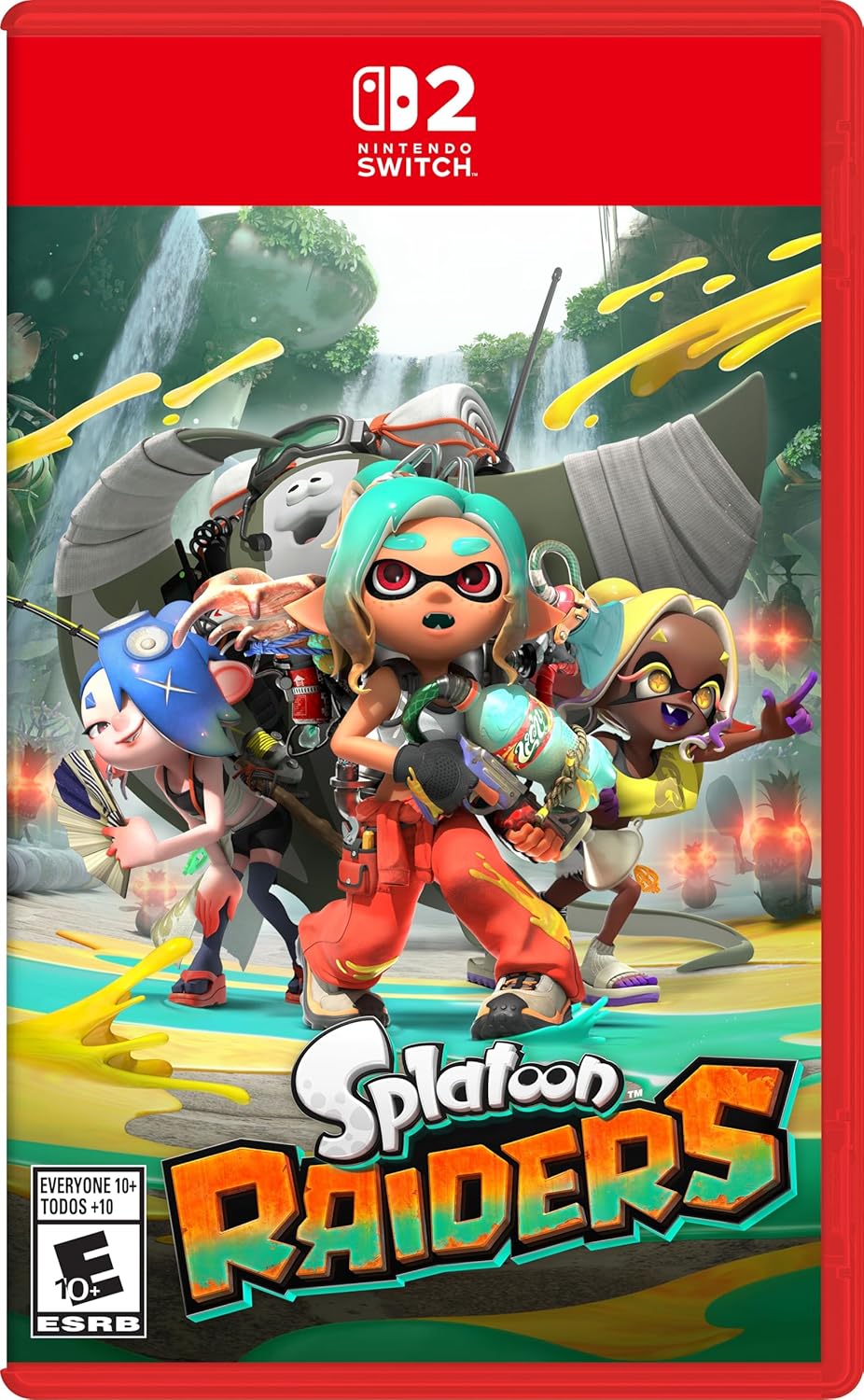
Every console generation eventually produces the one game that stops being a game you play and starts being an argument you point at for other people to buy the console. Not necessarily the best game on the system, but the one that most cleanly answers the only question a skeptic actually asks, which is why the new box is worth the money when the old one still works fine. For the Switch 2, a year into its life, that game has arrived from an unexpected corner. Splatoon Raiders is a spin-off of a multiplayer franchise, aimed partly at newcomers, and it turns out to be the most persuasive demonstration yet of what this hardware can do that its predecessor could not. It is also, and this matters less to the argument but more to the experience, an absolute blast.
Splatoon Raiders takes a series built entirely on competitive online ink-battles and does something the franchise has never tried in over a decade: it puts single-player first. You play as a mechanic exploring the Spirhalite Islands alongside the musical trio Deep Cut, working through a looter-shooter campaign against waves of the series' ever-present Salmonids, gathering materials, and building out your loadout as you go. Where mainline Splatoon was Nintendo asking what a Call of Duty might look like in its hands, Raiders is Nintendo asking the same question of a Rainbow Six-style loot grind, and the answer is a class-based progression system, three distinct tank loadouts favoring speed, power, or battlefield control, that lets you shape how you play. Developed by Nintendo EPD and released as a Switch 2 exclusive, it carries a lighter $50 price ($60 if you buy physical) that undersells how substantial it is. A four-player co-op mode exists, but the solo campaign is unmistakably the point.
There is a useful contrast to draw with Pokopia, the other Switch 2 standout this year, where you feel the machine's power on the back end, in the persistence of a world that remembers where you dropped an object a month ago rather than despawning it the way Minecraft would. That is real horsepower, but it is horsepower you appreciate intellectually. Splatoon Raiders puts the power directly in front of your eyes and hands. You feel it in the sheer volume of chaos the game sustains, screens crowded with Salmonids in numbers the original Switch could never have rendered, and in the responsiveness that keeps all of it legible and controllable no matter how dense the fight gets. This is the rare game that justifies its hardware through pure demonstration, and if you handed it to someone on the fence about buying a Switch 2, it would close the sale in an afternoon.
What keeps it from being a mere tech showcase is that the core loop is compulsively satisfying, and the reason is the grind. There is a specific joy to the progression here that is hard to find outside of Pokémon, a grind that never once curdles into a chore. You move through the islands hunting materials, leveling your tanks, and collecting the resources to craft new gear, and the game keeps that loop humming because the moment-to-moment act of fighting is so good that repetition never registers as repetition. I could take or leave the story entirely, and I mean that as a compliment in the Jurassic World sense, where you could read me the phone book for two hours as long as the T-Rex fight is coming. The story is the phone book. The loop is the T-Rex, and it never stops delivering.
The difficulty curve deserves specific praise, because it is the exact thing so many first-party Nintendo games get wrong in the other direction. A recurring frustration with recent titles, the Yoshi and the Mysterious Book, Super Mario Wonder, and Princess Peach: Showtime specifically, is that they are too easy, so gentle that the act of playing them carries no tension. Splatoon Raiders refuses that trap. It is challenging without ever being unfair, and it gives you enormous room to incrementally get better, to learn the flow of diving into the ink to hide and replenish, surfacing to fire, chaining gadgets together into combos. Every one of those systems is intuitive, and the game trusts you to figure them out through play rather than lecturing you. As someone who has historically avoided this entire genre, precisely because I do not enjoy being bad at something in my free time, I found myself hitting difficulty walls and actually wanting to get better rather than putting the controller down. That is the mark of a game that has calibrated its challenge exactly right.
The progression even solves a problem it creates. Leveling a single tank eventually requires resources you can only earn by playing a different one, which sounds like busywork and instead functions as a gentle nudge toward mastering play styles you would otherwise ignore. You go in wanting to main one loadout, get pushed into another to unlock the next tier, and come out the far side genuinely fluent in both, jumping between them by choice. It is a smart, low-friction way to make a player broaden their own skills, and it is rewarding rather than punishing every step of the way.
If there is one real criticism, it is a single design decision that nearly cost the game a point: the motion controls are on by default, and the option to turn them off is buried far enough that a new player can spend the first hour fighting the gyroscope instead of the Salmonids. Played that way, on motion, this is probably a four out of five, an experience undermined by a control scheme working against you. The moment you dig into the settings and switch to standard stick aiming, playing it like the third-person shooter it is, the whole game snaps into focus and becomes phenomenal. That the superior control option is something you have to stumble into, rather than being offered up front, is the one genuine misstep here, and it is worth flagging precisely because so many players will bounce off the default before they find the fix. Turn the motion controls off immediately, and the ceiling lifts.
Splatoon Raiders is the clearest single argument for the Switch 2 that Nintendo has yet produced, and it arrives in a first-year lineup that has been relentlessly, impressively dedicated to showing off what this console can do that the last one could not. This is the one I would hand to a skeptic. It is the one that most immediately and completely justifies the hardware's existence, and it does it while being one of the most purely fun games of a stacked year. Whether it or Pokopia ends up the game of the year is a genuine conversation, and that it is even in that conversation as a multiplayer franchise's single-player spin-off tells you how far it exceeds expectations. Turn off the motion controls, pick up a tank, and go. This is the console selling itself.