The coming-of-age story has a load-bearing requirement that is easy to overlook until a film gets it wrong: the authority figure holding the young protagonist back has to be, in some meaningful sense, mistaken. The whole engine of the genre is the gap between what the parent fears and what the child is capable of, and it only turns if the audience comes to believe the restriction was unwarranted, a product of caution calcified into control. Disney's Hexed, the studio's Thanksgiving original and its first non-sequel since Wish, is a beautiful film that stumbles over exactly this requirement, and the stumble, combined with a structure that tries to hold two movies in one, is what keeps a gorgeous picture at merely good rather than great.
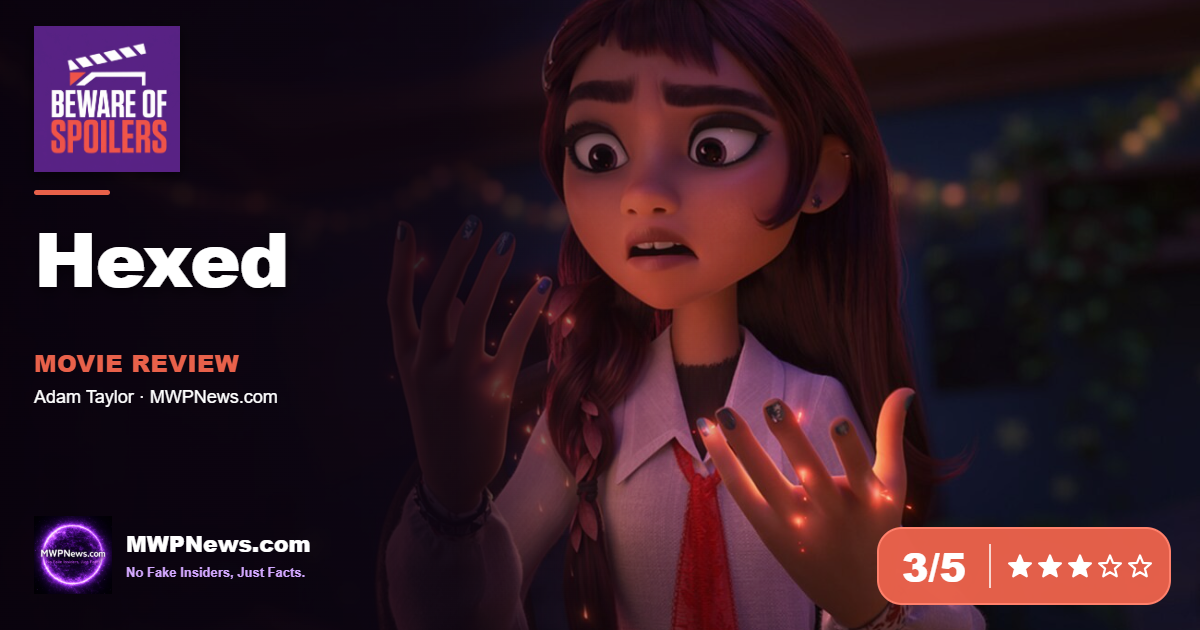
Hexed follows Billie Doe, a rebellious teenager in a sleepy Ohio town who has always felt like an outsider and who wears a strange stone on a string around her wrist, placed there by her mother for reasons Billie does not understand. It turns out to be a dampener, suppressing magical powers Billie did not know she had, and when the device comes off, it pulls her and her mother into the hidden magical realm of Hexe and into the path of Queen Celeste, the villainous witch who wants Billie's power for herself and looks vaguely like if Elsa from Frozen was a cougar. Hailee Steinfeld voices Billie, Rashida Jones her mother Alice, Jodie Foster the villain Celeste, and Walton Goggins the three-eyed cat Beef Roger. Fawn Veerasunthorn and Jason Hand direct.
This lands at a 3 out of 5, with a caveat that on a more generous day it nudges toward a four. Hexed wants to be a story about a daughter coming into her own while her overprotective mother tries to hold her back, the classic push-pull of a teenager straining against a parent's control. But the film undercuts that arc by giving the mother a legitimate reason to restrict her, because Celeste really is coming for Billie, really will try to take her power or worse, and hiding her in the ordinary world really is the sensible move. The trouble is that a coming-of-age story needs the parent to be at least partly wrong, and here the mother keeps being proven right. Several times across the film, Billie's assertions of independence lead to exactly the danger the mother was guarding against, which leaves the central conflict wobbling: you cannot fully root for the daughter's rebellion when the movie keeps demonstrating that the rebellion was reckless. The emotional core never quite settles because the film is at odds with itself over whether the mother represents something to overcome or something that was correct all along.
The premise compounds this with smaller logic snags that pull you out of it. If the entire goal is to keep Billie from discovering and acting on her powers, sending her to a school, where she is surrounded by exactly the social pressures that breed rebellion, is a strange choice; homeschooling would have served the mother's aim far better while preserving the same why-are-you-holding-me-back tension. And the film leans on environmental storytelling, the stacks of parenting books scattered around the house as the mother tries to manage her headstrong daughter, to establish just how rebellious Billie is, which makes it odder still that this supposedly defiant teenager has quietly worn an unexplained rock on a string her whole life without ever once trying to take it off. The one thing she accepts without question is the one thing the plot needs her to accept, and it shows.
The second problem is structural: Hexed feels like two movies condensed into one. It has the setup of a self-discovery story and the sprawl of a mythology-building epic, and it does not have room for both. The clearest symptom is the ending, which pays off a prophecy that the movie beats the audience over the head with just in case they are playing with toys or scrolling TikTok while watching, a witch destined to complete the building of Hexe so that everyone can share in its magic, and then plays coy about whether Billie is the chosen one before pulling the rug: it is not Billie, it is her mother. As a twist, it is a strange rug-pull for the movie this has been, and it reads like the climax of a second film arriving in the back third of a first one. All of this material crammed into a single ninety-nine-minute feature is simply too much, and the cramming is why the emotional beats that should land only sometimes do.
What keeps the film firmly in good-not-bad territory is that it is a pleasure to look at and frequently a pleasure to watch. The animation is gorgeous, the aesthetic of Hexe and the visual logic of how its magic works are inventive and lovely, and the whole thing is studded with strong comedic beats. Walton Goggins is the standout, nailing the three-eyed cat Beef Roger with exactly the kind of ripe, scene-stealing energy a sidekick like this needs, and the enchanted-object gags, a cauldron brought to life among them, are consistently fun. Some of the emotional moments do connect; there are just not enough of them, because the film's confusion about the mother keeps undercutting its own feeling.
One stranger note worth flagging is the soundtrack, which leans on licensed pop needle-drops to a degree that feels distinctly un-Disney. Between Demi Lovato's "Confident" and Dua Lipa's "Levitating," the film plays less like the studio's usual approach and more like a DreamWorks movie, where wall-to-wall contemporary pop is the house style. It is not a dealbreaker, and the single original song is fine, but the sheer volume of needle-drops is conspicuous, and it adds to the sense of a film slightly unsure of what it wants to be.
Hexed is a beautiful, entertaining, imperfect movie whose flaws are the familiar Disney kind: a plot that needed one more tightening pass. It is the same note that applied to Strange World, a film with real craft and real ideas held back by a structure that could not quite contain them, and a little more discipline here, a clearer sense of what the mother is supposed to mean and the restraint to tell one story instead of two, would have made this very good indeed. As it stands, it is worth a look in a theater, where its considerable visual beauty lands hardest and will likely not translate as well to a living-room stream. It is the kind of gorgeous, flawed, good-hearted movie that, in another era, you would have worn out a VHS copy of, and there are worse things for a film to be.