

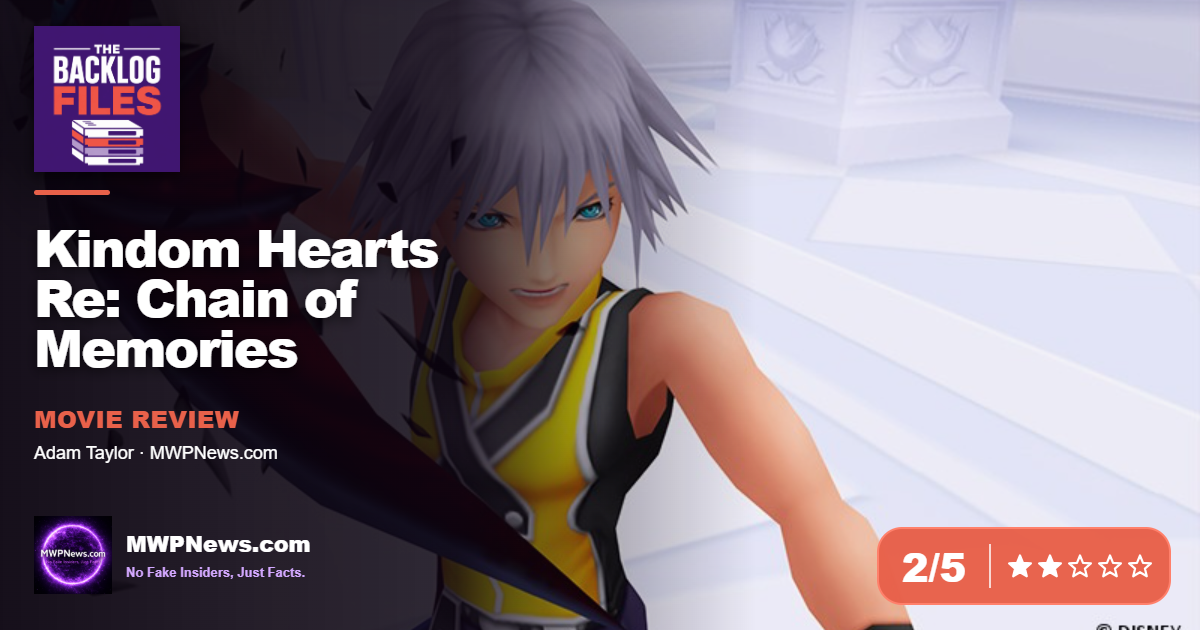
Every franchise has an entry that exists for reasons outside itself, a chapter shaped less by what its creators wanted to make than by the hardware they were forced to make it on. In the video game industry, and creative endeavours in general, this is not necessarily the worst thing and we've seen historically that necessity being the mother of invention can lead to some memorable experiences. Kingdom Hearts Re:Chain of Memories is one of the clearest examples in a major franchise that is still running today, a game whose entire combat identity was dictated by the limits of the Game Boy Advance, later remade in 3D but never freed from the design compromises baked into it from the start. Continuing a trip through the series via the new collection on current-gen hardware, and holding to the rule of judging each game as if it arrived today rather than through the fog of nostalgia, Chain of Memories is where that approach gets unkind, because what made sense as a clever workaround in 2004 reads now as a game that is simultaneously too easy and too much of a chore, redeemed almost entirely by a story it only sometimes earns the right to tell.
Re:Chain of Memories picks up directly after Kingdom Hearts, with Sora and company drawn into the mysterious Castle Oblivion, where their memories are stripped away floor by floor and reshaped into cards. The conceit is the mechanic: combat is built around a deck, with every attack, spell, and item represented by a card you play in real time, chaining them into more powerful “sleights” and breaking your opponent’s cards with higher-numbered ones. It is a novel idea and the remake implements it well enough. That said, the trouble is everything the idea runs into once you actually play it.
The core problem is that the card system fails in both directions at once. On one hand, it is far too easy to cheese. Certain sleights are so overpowered that they trivialize the game. Lethal Frame, Trinity Limit, Mega Flare each are essentially a button you can lean on to power through encounters that should have teeth. The deck-building freedom that is supposed to be the system’s depth instead becomes the tool for its own undoing, letting you stack the cards that break the game and never look back. The combination of Marluxia's enemy card and Lethal Frame make the final boss ridiculously easy. On the other hand, the game can be a slog, and the two problems do not cancel out so much as trade off, long stretches of tedium punctuated by trivially easy fights.
The worst of the tedium comes from mobility, a problem the first game had and this one makes more flagrant. Movement is sluggish, the recovery animation after your card gets broken is punishingly slow, and crucially the game is simply not built for the aerial combat several of its bosses demand. Ursula and the genie Jafar, with his lamp-carrying Iago circling overhead, both force you to fight in the air, and the engine, inherited from a first game that was never oriented around aerial combat either now made worse by the absence of abilities, fights you every step of the way. A boss that requires a maneuver the game cannot comfortably execute is a boss that becomes an exercise in frustration rather than skill. There are smaller irritations layered on top, card stats that are only visible buried in the journal rather than on the deck-assembly screen, which is baffling, but mobility is the thing that turns playing this into a grind.
Then there is Riku’s campaign, Reverse/Rebirth, which inverts the formula and fares worse for it mechanically. Where Sora can build and sort his own deck, Riku is handed a fixed deck each floor, which strips away even the compromised agency of the main mode and makes his story, structurally a boss rush, a miserable thing to push through. It is, like everything else here, very easy to get overpowered, but it is not fun to do so.
And yet Riku’s story is the best thing in the game, which is the central frustration. Narratively, it is a strong arc about Riku confronting the darkness inside himself, literally, as he fights manifestations of his own corruption, reckoning with how he let himself be used and made into a weapon across the first game, building toward a confrontation with Ansem. The literalization is a touch on the nose, fighting your inner darkness as a physical clone of yourself, but it works, and it is the richest character writing the series had produced to that point. This is the part of the game that makes the strongest case for the ground-up remake Chain of Memories actually deserves, far more than the first game does, because the bones of something excellent are here, trapped inside combat that undercuts them.
The game even shows you, once, how much better it (and realistically probably also Kingdom Hearts 2) could have looked. The fight against Marluxia, the scythe-wielding keeper of Castle Oblivion, gives him a spectacular alternate form, a towering figure with an enormous death-scythe aboard a vast ship, and it is striking. The problem is that it is the only time the franchise reaches for that, and it makes you wonder why none of the other Organization members got anything comparable, excluding Xemnas as the final boss of Kingdom Hearts 2. A single moment of real spectacle in an otherwise flat presentation does not elevate the whole; it just underlines how underwhelming everything around it is by comparison when the boss fights against Axel, Vexen, Larxene, and Replica Riku are just the same room with a different person to beat the crap out of.
There is also a structural wrinkle worth flagging for anyone coming to the collection fresh, which is that completing Chain of Memories fully requires engaging with the contemporaneous 358/2 Days content to unlock everything, and the series’ narrative progression is built on the assumption that you already know what happens here. Play these in order for the first time and you will either miss material unlockable through random drops that you would have to do a second time to get, which is mildly annoying, or get the story out of sequence, an awkward demand the collection does little to smooth over. And as with the first game, the Switch 2 version of this re-release ships without the achievements the Steam version has, removing even the external incentive a completionist might have leaned on to justify the grind.
Re:Chain of Memories is a 2 out of 5, the weakest stop so far on this journey, a game I enjoyed less than either the original Kingdom Hearts or its sequel because at no point did it stop feeling like busywork between better things. The story, Riku’s especially, is the lone reward, and it is good enough to make you wish it lived inside a game built to support it rather than one engineered around a handheld’s limitations and never fully liberated from them. It is a necessary step through the saga and little more, the kind of entry you push through to reach the next one. Fortunately, the next one is Kingdom Hearts II, the best the series has to offer, and after this, that is a relief.