

 Michael Johnston (Actor), Inde Navarrette (Actor), Curry Barker (Director) & 0 more Rated: R Format: Blu-ray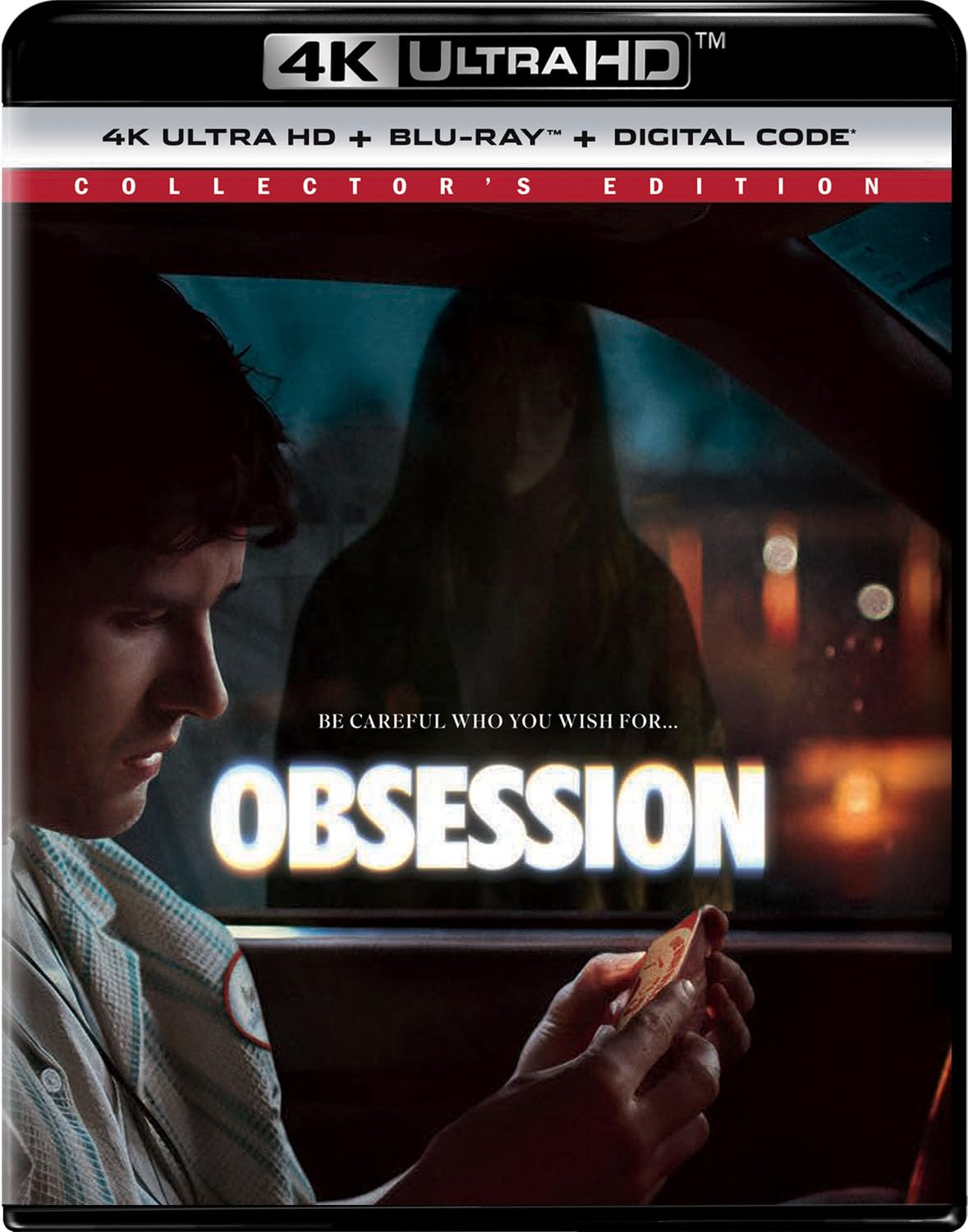
The best horror premises are machines for delivering a single, clean idea, and one of the cleanest of them all is the monkey's paw: you get exactly what you asked for, and the getting destroys you. It is a structure that has survived from a 1902 short story through countless retellings because it never stops being true about human wanting. The trick, for any filmmaker building on that foundation, is discipline. A wish-gone-wrong story lives inside its own fantasy logic, and the moment you puncture that logic with the weight of real-world consequence, the whole contraption can seize. Obsession, the runaway Blumhouse-backed horror hit that spent two months as the most hyped genre film of the year before landing on Peacock, is an incredibly strong movie that runs into exactly this problem in its final stretch, and the collision is the difference between a very good film and a great one.
Obsession follows Bear, a lovelorn music-store employee who cannot bring himself to tell his childhood friend Nikki how he feels, even when she gives him a direct opening to do so. Rather than take the risk, he turns to a mysterious wish-granting device called the One Wish Willow and wishes for Nikki to love him, which the object obliges by hollowing out the real Nikki and replacing her with an entity engineered to adore him above all else. Michael Johnston plays Bear, Inde Navarrette plays Nikki, and Cooper Tomlinson, Megan Lawless, and Andy Richter also star. Curry Barker, a YouTube filmmaker making only his second feature, writes and directs.
As someone who came to this film late due to both circumstance and a usual aversion to seeing horror movies in a theater, there is a lot of expectation that has been built up around finally seeing Obsession. After two months of the film being hyped as a masterpiece, no movie could have fully cleared the bar the discourse built for it, and some of my reservations may be the inevitable letdown of arriving late to a party everyone else attended at its peak. That said, the reservations are real, and they cluster at the ending. But the strengths are considerable, and they start with the film's central performance, which is extraordinary. Navarrette is asked to play several distinct versions of the same character, the real Nikki, the wish-warped devotion of the false Nikki, and the flickers of the true self clawing back to the surface, and she calibrates each with a precision that gives the film its whole engine. A quiet, devastating moment where the real Nikki surfaces just long enough to beg Bear to kill her, or the sound of her screaming from the purgatory the wish has trapped her in, land because Navarrette makes the layers legible. This is breakout work, and an Oscar conversation is not out of the question.
The thematic spine is sharp, too. This is fundamentally a film about male entitlement, about a man who cannot perform the basic vulnerability of stating a feeling and so reaches for a shortcut that lets him possess a person rather than grapple with emotions like an adult. Bear is, functionally, an incel, complete with a girl who is actually interested in him that he ignores in favor of the one who is not, and the film is clear-eyed about the horror of what he does. The monkey's-paw framing works beautifully in the middle stretch, the wish granted in the worst possible way, Bear slowly realizing that the thing he wanted is a prison for the person he claimed to love. When the film sits in that discomfort, in the gap between what Bear wished for and what he actually did to Nikki, it is unsettling in the way the best horror is.
That said, the ending breaks the machine. For most of its runtime Obsession operates in a heightened, self-contained fantasy world with its own rules, a world where a wish device can body-snatch a person and nobody quite behaves the way real people would. And then the climax abruptly imports real consequence and real trauma into that fantasy, and the two cannot coexist. The third act stacks up a body count, three of Nikki's coworkers dead by shooting, bludgeoning, and overdose, and then snaps the real Nikki back into consciousness in the middle of the carnage, forcing her to react with the genuine, shattering horror any human would feel waking up amid corpses with a gun she just pulled from her own mouth. It is a real emotion in a world that has spent ninety minutes telling you not to expect real emotions, and the tonal whiplash yanks you out of the film. This is the same problem that undid Lisa Frankenstein, a movie that also built a fantasy rule-set and then asked you to feel real grief inside it, and it does not work here for the same reason it did not there.
Worse, that tonal break carries a moral one. The instant the film makes Nikki's suffering real, the story stops being "be careful what you wish for" and becomes something bleaker and less controlled, the story of a man who comprehensively destroyed an innocent woman's life. Once you register Nikki as a real victim rather than a fantasy device, the questions the movie cannot answer come flooding in. She is left among three dead bodies with no possible way to explain what happened, her life effectively over, and the film simply is not built to hold that weight. The wish framing wants the ending to land on Bear's comeuppance, but the realness the movie suddenly insists on relocates all the horror onto Nikki, who did nothing. There is a version of this that works, one where Nikki retains more autonomy throughout, allowed to fight her way toward the surface the way a hypnotized person supposedly cannot be made to act against their nature, breaking through mid-act rather than only at the blood-soaked end. That structure would have kept her a character rather than a receptacle, and would have let the ending mean what the film clearly wants it to mean.
The other thing keeping this from a five is the friend group, which is too thinly drawn to carry the ending's stakes. Nikki's coworkers are uniformly unpleasant to one another, and the film seems half-aware of it, gesturing at a story told largely from Bear's warped point of view without committing to it. The whole thing might have worked better as a novel with Bear as an unreliable narrator, in the mode of You and its Joe Goldberg, where the "everyone around me is awful" framing is understood to be the protagonist's poison rather than the truth. On screen, without that interiority, the supporting cast reads as underwritten rather than filtered.
Obsession is a strong, ambitious, disquieting horror film held back from greatness by a final act that changes its own rules. Barker is a real talent, and the fact that a filmmaker can wring something this assured out of a sub-million-dollar budget is exactly the Blumhouse model working as intended, giving a distinct voice room to operate with minimal interference. It is the kind of movie worth catching up with even after the hype has crested, carried by a star-making performance and an idea with real teeth, and its flaws are the ambitious kind rather than the lazy kind. Just do not expect the ending to hold together as cleanly as the ninety minutes before it. On the strength of Navarrette alone, it earns a watch and I would not bet against a dark horse Best Actress nomination for her come award season.