

 Homer (Author) Format: Hardcover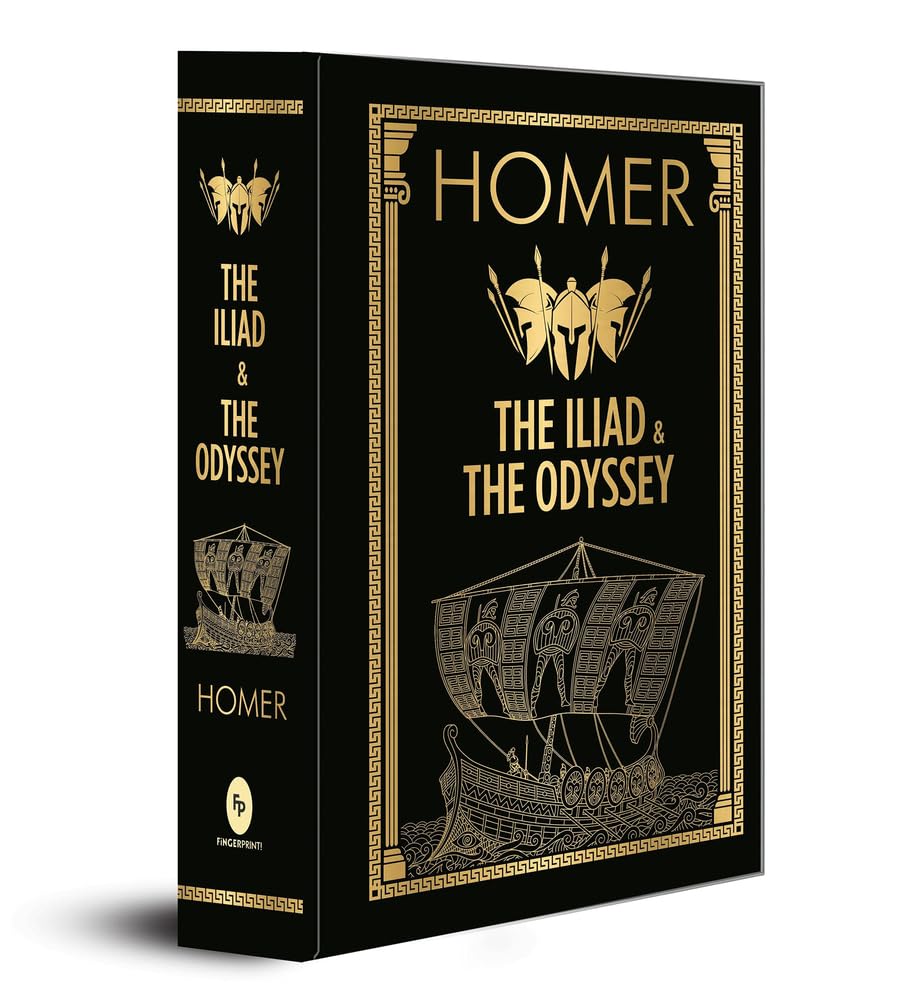
The oldest story humanity keeps telling is not about going to war, it is about what happens to the warrior when the war is over. You can find it in the Epic of Gilgamesh, older than the Abrahamic faiths and older than the Greek pantheon itself, in which a king who has done his fighting stands before a goddess who asks him what is left for a man once his purpose is spent. You can also find it, most enduringly, in Homer, whose Odyssey is less an adventure than a decade-long meditation on the impossibility of coming home unchanged in a world you helped fundamentally change. Christopher Nolan, following the Oscar-winning Oppenheimer with another study of a man defined by a single irreversible act, has made a film that understands this lineage in its bones, and The Odyssey is not only among his best works, but a clean, staggering five out of five, and clearly the finest film of the year to this point.
The Odyssey follows Odysseus, king of Ithaca, on his tortured ten-year journey home from the sack of Troy, beset at every turn by gods who have decided to make an example of him. As he wanders from the Cyclops's cave to the sirens' waters to Circe's island, his son Telemachus comes of age in his absence and his wife Penelope holds off a household of suitors who have all but declared him dead. Matt Damon plays Odysseus, and Tom Holland, Anne Hathaway, Zendaya, Charlize Theron, Robert Pattinson, and Lupita Nyong'o also star. Nolan writes and directs, with Ludwig Göransson scoring and Hoyte van Hoytema shooting the whole thing in IMAX.
The case for the film to be the best of the year begins with what Nolan has quietly become the best living practitioner of: deconstruction. The easiest way to explain what this means is with the example of the deconstructed dish; where a chef takes something familiar, breaks it into its component parts, and reassembles them into a form that hits the same notes in a different order. Nolan has been doing this his entire career, in Memento and The Prestige and Dunkirk, telling stories out of sequence while preserving, even heightening, their emotional throughline. What he does here is take a narrative with a fixed beginning, middle, and end, identify the emotional core of each movement, the ache of the warrior's return, the weight of a civilization-scarring transgression, and rebuild the whole thing around those distilled feelings rather than around plot mechanics. The result tells the same story you half-remember from high school, in an order you do not expect, and lands every beat harder for the rearrangement.
This is where the film's choice of source material turns out to be a stroke of genius, and it connects directly to why some of Nolan's imitators fail. Deconstruction only works when the audience has enough of a baseline to recognize the reassembly as clever rather than confusing. Batman v Superman tried to deconstruct two icons before the modern audience had been given a coherent, shared version of them to push against, which is why it collapsed where a comic like The Dark Knight Returns succeeded. Nolan sidesteps that trap twice now. Most people do not know the intimate biography of Robert Oppenheimer, and most people (like myself who last read it in high school 15 years ago) remember the Odyssey only in fragments, the Cyclops, the sirens with wax-stopped ears, Scylla and Charybdis, without the connective spine. That passing familiarity is the perfect canvas. There is enough recognition for the remix to resonate and enough forgetting that Nolan can rebuild the emotional architecture without fighting a fixed version in your memory. It is, frankly, the work of a generational talent, and saying so does not feel like fanboy excess so much as plain observation.
The thematic engine underneath all of this is what the film calls the law of Zeus, which is nothing other than the golden rule stated in its oldest surviving form: treat the stranger at your door with honor, because any guest might be a god in disguise, and to violate that sacred hospitality is to invite catastrophe. Telemachus names it explicitly early on in modern terms, and it reframes the entire epic. Odysseus does not merely suffer bad luck on his way home. He suffers because the Greeks broke that law at Troy, offering a gift, the horse, as a gesture of peace and using it to burn a city, a transgression so profound the film treats it as a wound to civilization itself. That single reframing is what elevates the movie from spectacle to tragedy. The gods are not capricious bullies here. They are enforcing a moral order the hero helped shatter, and his long road home is the bill coming due. It rhymes precisely with Oppenheimer, another film about a man who unleashes something on the world and must live inside its consequences, and Nolan's decision to withhold the glory of Troy and dwell instead on the reckoning is the whole point.
It is worth briefly addressing the noise that preceded the film, because it is instructive about how thoroughly it misreads what Nolan is doing. The casting drew the predictable online complaints about historical accuracy, which is a strange objection to level at a film populated by Cyclopes, sirens, and literal gods. This is not a historical reconstruction. It is avowedly mythological and allegorical from its first frame, and complaints premised on realism are aimed at a target the movie never pretended to be. That is roughly all the attention the manufactured controversy deserves, and it is the kind of bad-faith framing this show has taken apart at length elsewhere.
The Odyssey is the rare blockbuster that trusts its audience to sit with something ancient and difficult and be moved by it, and it rewards that trust completely. Damon has never been better, Göransson's score is thunderous, and the IMAX photography turns a three-thousand-year-old poem into the most immediate thing in any theater right now. It is Nolan operating at the height of a power almost no other filmmaker possesses, taking a story we think we know and making us feel it as if for the first time. It will take something extraordinary to top this before the year is out, and while Dune: Messiah and Digger loom as the films that might, the smart money says this is the movie to beat come awards season. See it on the biggest screen you can find, this is why the format exists.