

Every remake of a canonized classic walks into the same ambush. When the original is already regarded as one of the best games ever made, the remake cannot win on quality alone, because the quality was never in question; what it has to answer instead is a harder question: what did you add? It is the question that made the Resident Evil 4 remake’s Game of the Year nomination a debate a few years back, and the one that shadowed the lovely but inessential Paper Mario: The Thousand-Year Door remaster. A new coat of paint on a perfect game is pleasant and almost beside the point. So the real test of the Switch 2 remake of The Legend of Zelda: Ocarina of Time is not whether it is good, because of course it is good, it is Ocarina of Time. The test is whether it justifies its own existence, and the surprising, heartening answer is that it does, by being smart about exactly the right things.
Ocarina of Time needs little introduction. Originally released on the Nintendo 64 in 1998, it was the game that took the top-down, grid-bound Zelda formula and moved it into fully realized 3D space, inventing much of the template, lock-on targeting, context-sensitive actions, a vast traversable Hyrule, that action-adventure games have cribbed from ever since. It is, in the medium’s canon, the equivalent of a seminal text, the kind of foundational work video games point to the way science fiction points to Dune. This Switch 2 version is a faithful recreation of that game, rebuilt with visuals and performance the N64 could never have approached, and it is a Switch 2 exclusive carrying standard pricing rather than a budget tag, which only sharpens the what-did-it-add question.
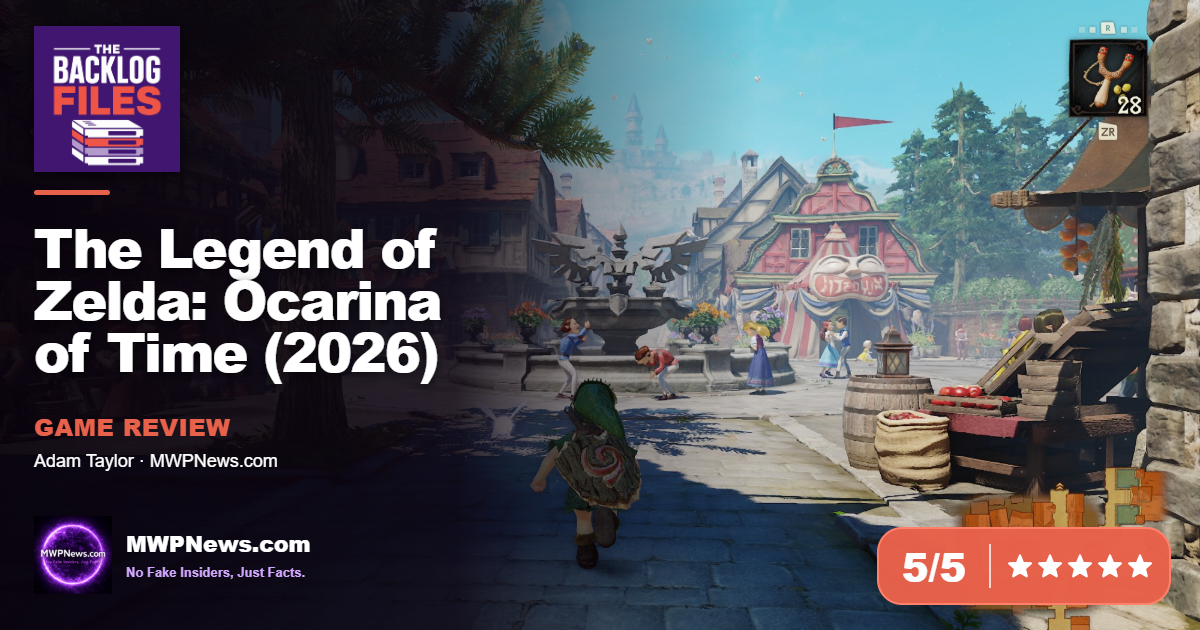
The quality-of-life improvements are where this remake does its work, and the smartest of them are borrowed directly from Breath of the Wild and Tears of the Kingdom. A quick-select system mapped to the R button and the D-pad eliminates the constant menu-diving that dated the original, and the Ocarina now lives right on the screen. Most tellingly, the improvements target the exact friction points that gave the original its worst reputation. The Water Temple, a level so infamous for its tedious menu-management of the iron boots and its obscure water-level puzzles that it became a byword for frustration, is substantially smoothed here: you no longer menu in and out to equip the boots, and the game guides you toward the water-raising mechanisms with lighting cues rather than leaving you to remember their locations cold. These are not flashy additions, but they are the right ones, surgically removing the dated annoyances while leaving the design intact.
What is most impressive is the restraint, because the wrong version of this remake is easy to imagine. There is a world where a studio takes Ocarina of Time and loads it with the parry-heavy, stamina-gated combat of the FromSoftware era, the Dark Souls and Bloodborne grammar that so many action games now default to, and calls it modernization. This remake declines that temptation almost entirely. A limited form of more deliberate combat is available, but only to a small degree, and the game is firmly better for it. Ocarina of Time’s combat was never meant to be punishing in that register, and forcing it into one would have betrayed the thing rather than updating it. Knowing what not to change is as much a skill as knowing what to, and this remake has it.
It is not without flaw, and it is the same one that applied to the recent Star Fox remake: it feels small. Older games tend to be shorter, constrained by what a cartridge could hold, and no amount of visual overhaul changes the underlying scope. Once you gain access to Epona and can gallop freely across Hyrule, the world reveals itself as more compact than memory and modern expectation suggest, and the game can feel smaller than it needs to be. This is not a knock on the design so much as an honest acknowledgment of what a faithful remake inherits; you are getting a 1998 game’s footprint with 2026 fidelity, and the two do not always sit flush.
The flip side of that smallness is a virtue the remake wisely preserves: it refuses to hold your hand. This is one of the most satisfying things about it, the way it trusts you to figure things out rather than papering the screen with prompts, even with the gentle Water Temple guidance noted above. The game lets you get things wrong in instructive ways. In the fight against Dark Link, the mirror-image mini-boss, the “intended” easy method apparently involves a hammer, which I did not have, because I had reached the fight out of the expected order and was meant to clear the Fire Temple first. Rather than block that path or scold me for it, the game simply let me work out Dark Link’s attack patterns and beat him the hard way, and discovering the intended shortcut only afterward. That openness, the freedom to approach the world slightly out of sequence and succeed through understanding rather than obedience, is exactly the kind of design modern games have largely sanded away, and preserving it is one of the remake’s quiet triumphs.
The Ocarina of Time remake is the rare re-release of a classic that clears the bar it sets for itself, answering the what-did-you-add question with a confident, considered list of the right modernizations rather than a hollow graphical facelift. It takes one of the most important games ever made and makes it cleaner, smoother, and more pleasant to play across a dozen small dimensions, from the quick-select to the improved jumping and swimming, without ever losing what made it matter. If you have a Switch 2, this is worth the pickup, both as a gorgeous way to experience a foundational work and, for a lapsed or latecoming fan, as exactly the kind of on-ramp that makes you want to go deeper into the whole franchise. It is a masterpiece, modernized by people who understood why it was one. See Hyrule again, or for the first time.