
 Adam Taylor
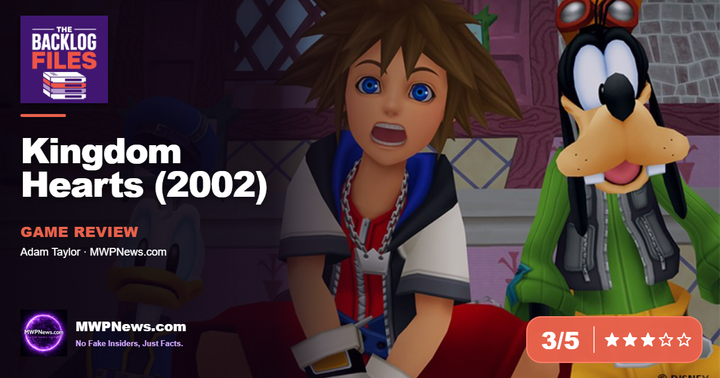
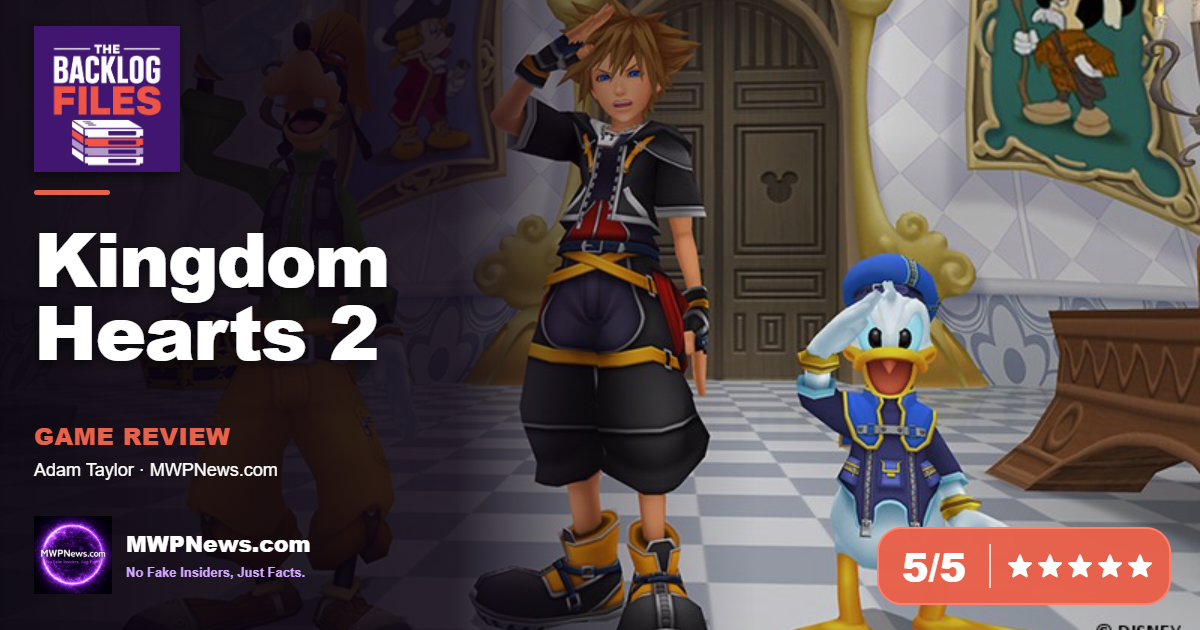
The clearest sign that a game was ahead of its time is that you can return to it two decades later and find almost nothing you want to apologize for. The first two stops on this trip through the Kingdom Hearts saga each required a certain generosity, the original a foundational but unrefined experiment, Chain of Memories a hardware-bound compromise that has not aged gracefully. Kingdom Hearts II requires none of that. Of the three entries covered so far, judged honestly and without leaning on nostalgia, it is the one that holds up best by a wide margin, because so much of what it does mechanically was not just good for 2005 but genuinely ahead of it. This is the high point of the series to this point, and it is the game you would hand anyone to explain why this strange Disney-and-Square chimera ever worked at all.
Kingdom Hearts II picks up the thread of the first game and its interquel, following Sora, Donald, and Goofy as they resume their journey across the Disney worlds, now contending with the Nobodies and the shadowy Organization XIII, a new faction whose mythology expands the saga considerably. The story takes real care to build out the existing lore, introducing the realm of the Nobodies and the architecture of a world that never was, deepening the universe without collapsing under its own weight. It launched in 2005, here presented in its enhanced Final Mix form within the collection, and from its opening hours it feels like a different and more confident animal than what came before.
The combat in Kingdom Hearts II is fluid in a way the series had never managed before, with a real sense of weight behind every strike, more intuitive movement, and a defensive game, blocking, parrying, repositioning, that anticipates the vocabulary modern action games would later standardize. It reads, in hindsight, as proto-Dark Souls: not in difficulty or structure, but in the feel of deliberate, reactive, movement-driven combat, where repositioning is as important as attacking and defense is woven into how you move rather than bolted on. The Final Form, with keyblades orbiting Sora and movement that carries its own built-in blocks, is the clearest expression of how modern this all feels. Where the original's combat fought you and Chain of Memories abstracted it into cards, Kingdom Hearts II simply nails it, and that fluidity is the foundation everything else is built on.
The smartest single addition is the Drive Forms, which transform the way you engage with every fight. The summons in the earlier game were an afterthought, I never used them beyond Tinker Bell, whose revive made her the only one worth the slot, and even here the summons remain largely skippable outside a cup or two. But the Drive Forms override all of that. By channeling Sora into more powerful temporary states that augment his abilities in distinct ways, the game gives you a mechanical toy box that rewards experimentation and keeps the combat evolving across the whole runtime. It is the kind of system that makes a game feel generous, and it is a large part of why Kingdom Hearts II is so easy to drop into and out of while remaining consistently rewarding. The difficulty is real but never punishing for its own sake; the challenge pays you back for engaging with it.
The Final Mix content is where that quality becomes a test, and it holds up remarkably. The additions, the data replica battles against the full Organization, the superboss fight against the Lingering Will, the whole brutal stretch of the Cavern of Remembrance you must survive to reach them, feel strikingly current, a gauntlet of skill checks that would not be out of place in a modern action game built around optional superbosses. Refighting every Organization member is a fantastic test of strength and knowledge of the interconnecting systems, and earning the right to even attempt it, by clawing through the Cavern, gives the whole thing stakes. The only soft spots are Mushroom XIII, a set of puzzle-like optional encounters that are the weakest wrinkle in the package because they all require a certain amount of luck, and the Battle of the Thousand Heartless, the game's famous mass set piece at about the midway point, lands smaller now than memory insists, undercut by the realization that the swarm is really only two enemy types, both of whom have a very simple reaction command to wipe out entire waves.
It is worth saying a word in defense of the thing Kingdom Hearts is most mocked for, which is its lore, because Kingdom Hearts II is where the mythology really begins to sprawl, and the sprawl is not the liability people make it out to be. The series is the poster child for the complaint "do we really need all this?" and the honest answer is yes. Played in sequence, the convoluted mythology actually coheres; it earns its complexity, even when it is, no pun intended, a little goofy, in a game that can pause its grand metaphysical plot to have Goofy flattened by a boulder, seemingly killed, benched for a stretch, and then revealed to be perfectly fine. That tonal whiplash between cosmic stakes and Disney slapstick is not a bug; it is the whole strange appeal, and Kingdom Hearts II balances the two better than any entry before it.
Kingdom Hearts II is a 5 out of 5 and the finest game the series has produced to this point, the one entry so far that needs no asterisk, no era-adjusted grading, no plea for patience. Its combat is fluid and modern, its Drive Forms are a stroke of design, its lore rewards the investment, and its Final Mix gauntlet still feels like a contemporary challenge. If someone asked where to start with Kingdom Hearts today, this is the game I would point them to, not out of the sentimentality of it being where I happened to begin, but because it is simply the best-playing, most confident, most rewarding entry in the saga as it stands. The first game laid the foundation and the second built something that still stands tall on it. Birth by Sleep is up next, and it has a very high bar to clear.