
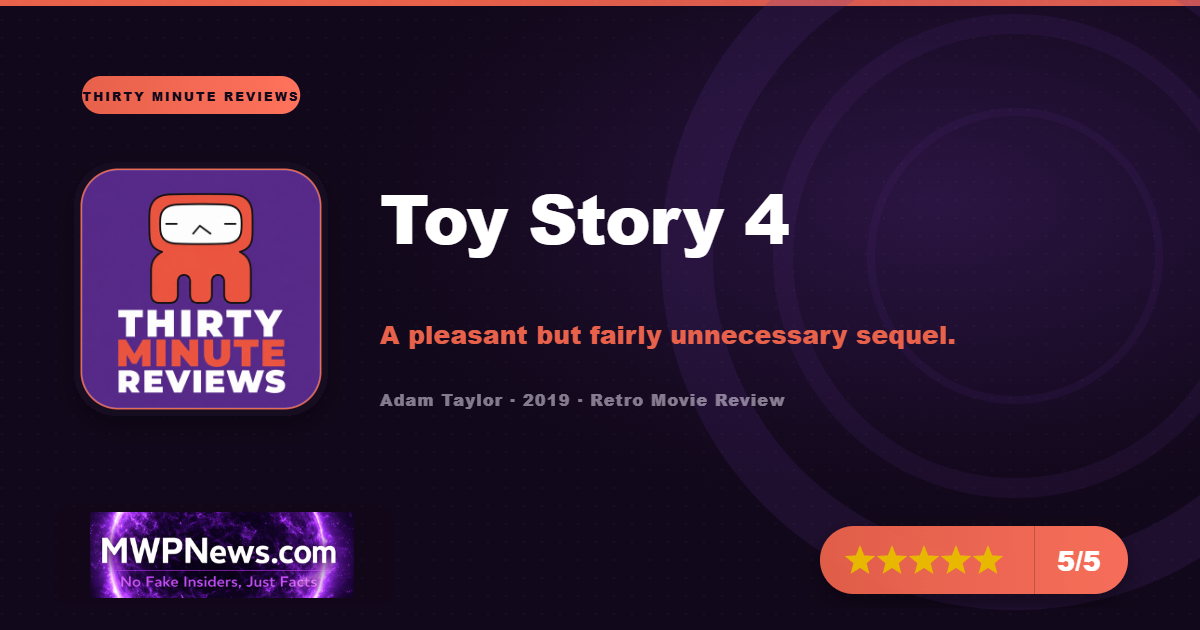
There is a moment in the life of every animation studio when it stops asking whether it should make a sequel and starts asking only how. Pixar spent its first fifteen years as the rare studio that earned the benefit of the doubt, the one whose follow-ups (Toy Story 2, Toy Story 3) were not cash-ins but arguments for why the story needed to continue. Toy Story 4 is the film where that calculus quietly inverts, where the question shifts from whether Woody had another chapter in him to how cleanly a beloved property could be slotted into a release calendar. It is not a bad movie. It might be the most telling kind of good movie, the competent, pleasant, faintly unnecessary sequel that signals a studio has figured out it can simply mandate these now and have them work.
The film picks up with Woody (Tom Hanks) struggling to find his place in a world that no longer needs him quite the way it used to. His kid, Bonnie, has made a new favorite toy out of a spork, googly eyes, and pipe cleaners, a skittish creation named Forky (Tony Hale) who is convinced he is trash rather than a plaything, and Woody appoints himself the guardian of this fragile new life. A road trip detour reunites him with Bo Peep (Annie Potts), now living free of any child as a self-possessed lost toy, and the reunion forces Woody to weigh the only purpose he has ever known against the possibility of a life on his own terms. Keanu Reeves as the daredevil Duke Caboom, Christina Hendricks as the antique-shop doll Gabby Gabby, and Jordan Peele and Keegan-Michael Key as a pair of carnival-prize plush also star.
The film's most interesting idea is the one buried in Forky, and to be clear, it is a bit of a thorny one. The movie poses, almost despite itself, a question about when a toy's life actually begins, the instant of creation or the instant of being loved, and it brushes up against philosophical territory heavier than a summer Pixar release tends to volunteer for. It does not really pursue the thought to any uncomfortable conclusion, which is probably wise, but Hale's performance gives the existential panic real comic life. If you have seen his work on Veep or Arrested Development, you know exactly the register of anxious, eager helplessness he brings, and Forky is that instinct distilled into a plastic utensil that wants only to return to the bin. He is the best new thing in the film by a comfortable margin.
The trouble is everything around him is forgettable in a way the earlier films never were. This is the point worth dwelling on, because it is the whole case against the movie. A rewatch reveals a cast stuffed with talent (Reeves, Carl Weathers in a small role, the Key and Peele duo) that simply does not stick in the memory the way Toy Story 3's incinerator climax or Lotso's heel turn did. The voices are doing fine work and the film moves briskly and lands its jokes, but large stretches evaporate the moment they end. Some of that is a visual problem. Pixar has by now perfected a kind of hyperreal plastic sheen, and ironically the closer these characters get to photoreal, the more they read as distinctly artificial, the more they look like merchandise. The original Toy Story worked partly because toys did not need to look human, sidestepping the uncanny valley by design. By 2019 the studio had engineered that warmth into something closer to a robotic science, technically flawless and emotionally a half-step cooler.
It is worth noting where this lands in the larger arc, because Toy Story 4 is best understood not as the fourth chapter of a story but as a proof of concept for a strategy. It arrived in a 2019 stacked with Disney sequels and remakes, a year engineered to leave the company in maximum financial health, and it slotted into that machine perfectly. Toy Story sells parks, sells toys, sells home media, sells whatever a Disney Channel slot can hold, and the lesson the studio took from this film is that it could reliably manufacture more of that, that a sequel could be willed into existence on a schedule and still clear the bar of being worth the trip once. That is not nothing. But it is a different proposition from the sequels that earned their place, and you can feel the shift.
Toy Story 4 is a solid, entertaining, slightly weightless film, and that is precisely the verdict. There is nothing glaringly wrong with it and little that reaches out and grabs you. It opens the world up enough to justify the journey and gives Woody an ending that, taken on its own, has real grace to it. It is worth seeing at least once, and it is unlikely to be a film you return to the way you return to its predecessors. Hopefully the people steering the franchise remember that the entries people actually rewatch are the ones that had a reason to exist beyond the spreadsheet. This one is good. It just is not essential, and with this series, good used to be the floor rather than the achievement.
★ ★ ★ ★